Friday, March 4, 2016
Periodic Comet P/2016 BA14 (PANSTARRS)
COD Q62
OBS P. B. Lake
NET PPMXL
PK16B14A C2016 03 03.43620 05 51 24.42 -34 16 10.7 18.4 N Q62
PK16B14A C2016 03 03.43801 05 51 24.54 -34 16 08.7 18.3 N Q62
PK16B14A C2016 03 03.43976 05 51 24.62 -34 16 06.7 18.5 N Q62
PK16B14A C2016 03 03.44150 05 51 24.72 -34 16 04.9 18.4 N Q62
PK16B14A C2016 03 03.44324 05 51 24.83 -34 16 02.8 18.2 N Q62
PK16B14A C2016 03 03.44498 05 51 24.95 -34 16 01.1 18.3 N Q62
PK16B14A C2016 03 03.44672 05 51 25.05 -34 15 58.9 18.2 N Q62
PK16B14A C2016 03 03.44860 05 51 25.15 -34 15 56.9 18.3 N Q62
PK16B14A C2016 03 03.45035 05 51 25.26 -34 15 55.1 18.3 N Q62
PK16B14A C2016 03 03.45209 05 51 25.35 -34 15 53.2 18.2 N Q62
PK16B14A C2016 03 03.45383 05 51 25.47 -34 15 51.0 18.3 N Q62
PK16B14A C2016 03 03.45557 05 51 25.57 -34 15 49.2 18.4 N Q62
Looking forward to a nice telescopic show late in the month whilst we are at NACAA.
Monday, August 24, 2015
Australian Science Week - its a wrap!
On Aug 12th, I was in Canberra for work and snuck out in the evening to catch the Science in the Pub sponsored by the ANU and the Australian - American co-operation through the US Embassy. The session was led by Prof Brian Schmidt (ANU), Dr Alan Duffy (Swinburne) and Glen Nagle (CSIRO/ANTF). An amazing session debriefing all the latest data from the NASA New Horizons, Pluto mission. If you had told planetary scientists only 6 weeks ago there was frozen nitrogen glaciers filling in old craters on Pluto, it would have been beyond their wildest dreams, yet that is exactly what they have found.
Friday 21st Aug The ANU/RSAA Stargazing night smashed two world record's for single-site and multiple-site observers with telescopes observing the night sky for 10 consecutive minutes. We were all a bit nervous about the weather, but the clouds cleared out just in time to ensure the night was a great success and everyone had a great time observing some fantastic sights through the larger telescopes. 76 people from the school community and nearby residents came out for one of the many local Melbourne sites at Norwood Secondary College in Ringwood. My trusty 14inch dobbie (dobsonian) was a hit, with people stunned and amazed looking at individual craters on the moons and counting the moons of Saturn which could be seen beyond the glare of the magnificent rings.
Mt Stromlo observatory in Canberra smashed the single-site Guinness Book of Record with a massive turnout of 1800 observers. The tally for the multi-site is still being finalized but was believed to have been over 10,000 people around the country. Once official it should easily eclipse the previous record of 3006 set in April 2013 in Mexico. Go Aussie!
Saturday 22nd Aug was a great night as well. The Scienceworks' Festival of Astronomy and Light opened up Scienceworks into the evening and I took the dobbie along again as one of the astronomers providing telescopes for viewing by the general public. Its amazing to watch kids who have never seen a telescope before walk up to one and try and work out which end/lens/mirror to look through. All are completely amazed at whats going on with all the lens and mirrors and when they see a crater on the moon as big as Tasmania it just blows them away. I have often described Astronomy as the "cupid's arrow of science", because of the emotional impact on people the first time they see the rings of Saturn or the craters of the moon. [That's original you have to quote me ;-) ]
As a veteran of many starparties it takes a bit to impress me, however I was not to be disappointed ........ a WORKING Tile from the Murchison Array had me fan-boying with selfies. It was sitting there on the grass collecting signals from the universe quite happily. Some 128 of these tiles currently form the Murchison Array, and will be a key part of the Square Kilometer Array that will put Australia at the forefront Astronomy research. If your dream is to win the nobel prize for Astrophysicis - Get into astronomy, go to the ANU or Curtain Uni in WA, and get onto the SKA (once built) and start data mining!!!!
Image: Selfie with "Popup Radio Telescope" - one tile of the Murchison Array actually working at Scienceworks.
What better way to wind up the week on 23rd Aug with some actual science supporting NASA's OSIRIS-REx Mission working with University of Arizona's Citizen Science Project - Target Asteroids. Laneway Learning, a novel idea that started as a way to increase traffic to a little coffee shop called the Little Mule Cafe (in a dead end laneway), has now gone global due to its outstanding success. Laneway Learning run eccentric little classes on just about anything to promote community engagement and sharing of ideas. I have run three "Asteroid Hunting" classes and become a regular at their Sunday Science Spectacular during Science Week.
Over a couple of hours about 10-20 people helped classify and record the photometry of asteroid Magellan, an analog of asteroid Bennu, the target of the 2018 OSIRIS-REx NASA New Horizons Mission. Asteroid Bennu is a carbonaceous asteroid and 3rd on the Sentry Risk Table that requires careful watching by amateur and professional astronomers alike. Bennu is a 492m asteroid that (at this stage) will pass at about 1/3 the distance to the moon in 2182. Saving the lives of your great grandchildren on a Sunday afternoon during science week - what could be better than that!
This is a photo of my little booth at Captain Melville's for the Sunday Science Spectacular.
All in all a great effort, thanks to Norwwod Secondary College, Mount Burnett Observatory, Scienceworks, Captain Melville's and Laneway Learning for putting up with me enthusiastically waving my arms about and carting large telescopes, screens and computers around.
Monday, October 21, 2013
ACCELN Learning network -Space Education
Thursday, August 29, 2013
New chasing old
Monday, May 16, 2011
Comet Elenin in "oncoming traffic"!!!

Update 23/5/2011
The moon is now wanning and I have re-visited Elenin on the 23rd to see how it is after the moon has passed through. This color composite image is stacked once to create a star layer, and again for movement of the comet, to get the coma nice and tight. The two layers are combined in photoshop with a feathered cutout in the star layer revealing the Comet layer behind. This is the quick and easy way of good color comet photos, given the comet is still pretty faint. The image is a one hour of RGB in 300sec subs, processed in Maxim DL (stack & combine) and Photoshop(curves and layers). If you look carefully you will see Elenin passing a tiny little distant Galaxy.
Enjoy!

Original Post.
The full moon is not the best time to be imaging comets - but what the hell! I had a focal reducer fitted to the planewave this week taking it down to F/4.4 so I had to shoot something to try it out.
Here is the latest image of comet Elenin, May 16th at 2011-05-16 03:54:21 UTC, this time in color. I was processing the images and noticed a couple of asteroids very close which certainly made it a worthwhile exercise, even if the images were a bit noisy from the full moon.
This image is 5 x 300 secs of each color R/G/B color combined. Each image tracked the movement of Elenin, thus trailing the background stars slightly in each color.

Passing in the opposite directions across the plate are Asteroid Zoya (1793) at Mag 15.9 and (7503)1996 VJ38 which appears to have "crossed" the (apparent) path of Elenin perhaps about 8-10 hours before my images photos were taken.
Also when the moon is bouncing around it will often give extra highlights to dust donuts that flats normally remove when its nice and dark.
Enjoy!
Astroswanny
Friday, March 11, 2011
Carnival of Space 188.
Image Credit: incasinoout777 at Goodtime webshots (Ferris Wheel in an earthquake).
The inexorable subduction of the pacific plate regularly brings earthquakes to Japan. We often pause briefly to admire the readiness and civil defense response that shows their preparation and courage to deal with such events.
Today the world stops to catch its breath and stand with Japan in the face of this monster earthquake and tsunami. It brings the realization to all of us, the tenuous hold we have on life, on this our "third rock from the sun".
Plate tectonics allow life to exist, brings us our rich volcanic soils, and yet can take life with such savagery that stuns us, and causes us to ponder.
To the people of Japan, and all our friends in the astronomy community in Japan -
我々の思いはあなた達と共にあります
Welcome to this week's Carnival of Space #188.
I am constantly amazed that up to 60-90% of traffic to my own blog comes from mobile devices, in the spirit of that, today I will provide a QR Scan code to each of the Home Pages of our intrepid bloggers. Download your preferred QR Scan code app from your handheld device provider and away you go.
So here we go its Carnival Time!!!!
In keeping with the reflective tone, Steve Tilford's personal tribute on the passing of his friend and mentor Dr Jim Elliot, covers his life, his philosophy and great discoveries (eg. he was on the team that discovered the rings of Uranus). Steve's detailed coverage has collected some thoughts and reflections from other scientists about the legacy Dr Jim has left us all. Read it, and ask yourself the question - what legacy will I leave?

Steve's Astro Corner QR Scan Code.
Vega 0.0 also takes some time to reflect - on pioneer astronomer Friedrich Wilhelm August Argelander's work and covers "método Argelander"(Argelander method) for observing variable stars. This article is in Spanish, which gives you a second reason to try out online translation tools this week.

Vega 0.0 Blog QR Scan Code.

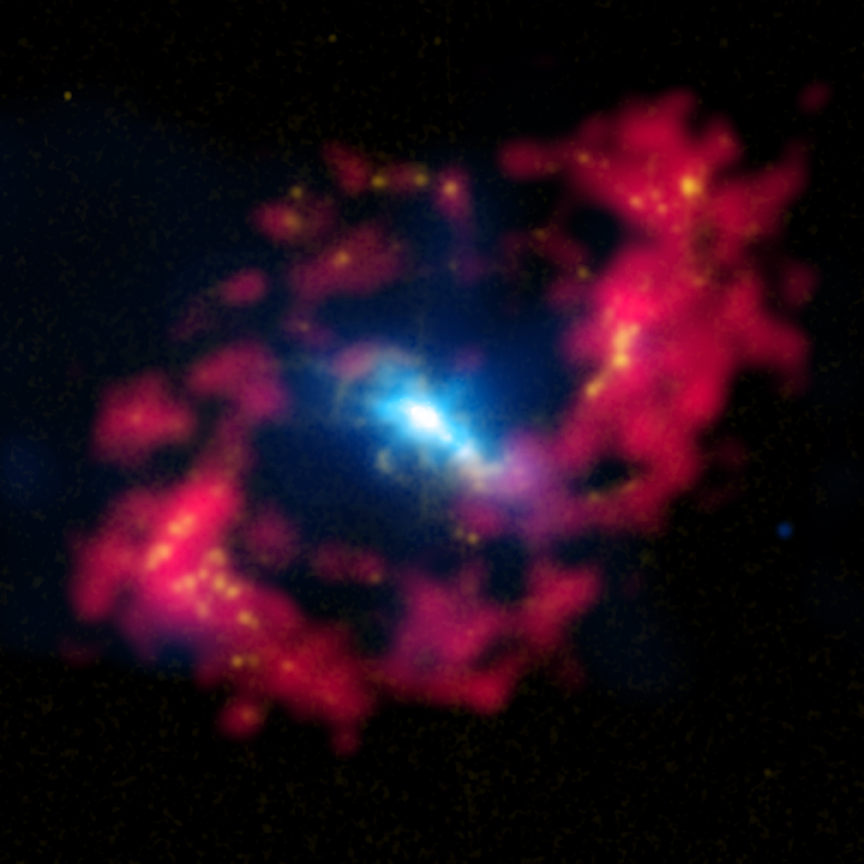
Chandra Blog this week features a stunning image of NGC 4151, a spiral galaxy with an actively growing supermassive black hole at its center. The structure has been dubbed "The Eye of Sauron" by astronomers due to its resemblance to the character in "The Lord of the Rings" movies. The image is a composite of X-ray, Ha and Radio spectrum. Read the amazing story of how this image was compiled.

Chandra Blog's QR Scan Code.
Next Big Future reports this week on Russia's plans for a megawatt nuclear space reactor and using it for space tugs and Mars missions. Brian continues the "powering up" theme with VASIMR's plans for the next 5-10 years and getting up to 1-6 megawatt missions.
Sounds like they'll have enough power budget for blutooth .......everything is better with Blu......(yes, yes we know)[Bigbang Theory].
Brian also updates us on details of the minimag Orion for near term interstellar missions. The full paper is available for free online.

Next Big Future QR Scan Code.
AstroBlogger reports on the post paper forensics of claims that fossil bacteria have been found in a meteorite. It's just magnesium sulfate nanobelts folks.
AstroBlogger QR Scan Code.
TheSpacewriter continues on the meteorite story and takes on the journalistic ethics of those who ran with the meteorite-life story last week and didn't bother to check the facts. Carolyn is much more qualified than I am to say what you can and can't do in 72 point font.

TheSpaceWriter QR Scan Code
At Cheap Astronomy, Steve takes us to places far, far away and talks in one of his well respected podcasts about about dwarf galaxies - large and small.

Cheap Astronomy QR Scan Code.
At WeirdWarp, Chris tries to lift the self esteem of asteroids by suggesting more useful things for them to do than killing dinosaurs. Arriving on an asteroid second after someones been there for a fit-out seems perfectly logical. Think big people!
Maybe we CAN send the telephone sanitizers first. [Hitchhiker's Guide to the Galaxy].

WeirdWarp QR Scan Code
Now you might think that Asteroids have a self esteem problem, but what about Ceres. Astropixie puts Ceres "on the couch" for a session on why Pluto had it coming!! [Warning: contains astronomy terms that might not be suitable for astronomers young enough to not know what a ...hmm ..."two body problem" is"].

Astropixie QR Scancode.
As opposed to being demoted, what if you never made it in the first place? A brown dwarf, about 75 light-years from Earth, has hit a new low. In fact, its temperature is so low that it is about the same temperature as the cup of tea sitting on Ian's desk. Discovery News asks the question: Stellar-Failure or just misunderstood?

DiscoveryNews QR Scan Code.
Nancy, Senior editor of Universe Today features an article on the Catalin Fus image of STS-133 mission to the ISS passing infront of the sun past the currently active sunspot region.

Universe Today QR Scan Code.
So, as we bring the Carnival of Space 188 to a conclusion, mindful of the powerful forces at work on our planet, in our galaxies, and yes even in our failed stars, lets use this time of confronting disaster for personal relfection on the legacies that have been left by others and the ones we might leave.
I leave you with a lovely image of M106 taken by John Nunn this week on my telescope.


Astroswanny's AARTScope Scan Code.
The Carnival of Space is a community of interest blog carnival bringing together the best and brightest Astronomy & Space Blogs at a single point in space and time (commonly referred to as a web address) each week. Previous episodes can be found here. If you run an astronomy or space science blog you can contact carnivalofspace@gmail.com to be added to the editorial circulation list.
Sunday, August 16, 2009
FMOs - Fast Moving Asteroids
Our little blue green planet moves along around the sun and travels even faster with reference to the cosmic background radiation. So next time someone asks you how fast you can run, you can say "almost as fast as Usain Bolt so long as you use the cosmic background radiation as the reference point not the finish line".
Ah I digress....so what constitutes fast is an interesting discussion you can have for many hours over a glass of red wine.
From the reference point of earth most Asteroids are found in a number of "belts" between the orbit of Mars and Jupiter and of the roughly half a million discovered currently only 1067 occasionally wander into our neighbourhood. These are classified as PHAs and are defined as Asteroids that have a minimum orbital intersect with earth of <0.05 AU (1AU is the distance from the sun to the earth).
The Minor Planet Centre, International Astronomy Union, Spacewatch and NASA JPL lead the charge in identifying and tracking asteroids, after setting a goal in the 1990s to find 90% of the Asteroids larger than 1Klm within 10 years.
Whilst Astronomers from the LINEAR, LONEOS, NEAT, and the Catalina Sky Survey, do the bulk of the legwork in the northern hemisphere, the Uppsala Telescope at Siding Springs in Western New South Wales, bats well above its weight in covering a good portion of the southern sky.
The Telescopes at Moorook D90 are well postioned to do quick follow up work for the professional Astronomers.

Fast moving asteroids are classed as FMOs, which by virtue of their speed usually mean they are fairly close to earth. Most however are relatively harmless as they are usually very small. The fantastic advances in technique honed over the past two decades, and the better technology now available means that asteroids as small as 4 Metres are regularly detected in the surveys.
On the 14th Aug E12-Siding Springs Survey on the Upsala Telescope detected object 2009 PR1 a 42m near earth object which zipped past earth at 7.9 Lunar distances on the 12 August.
The author captured this shot (above) shortly after it was posted on the MPC Confirmation page.
FootNote:
This Blog is posted as a tribute to all those hard working folks in the Asteroid watch programs around the world.
Search