Tuesday, May 29, 2012

Asteroid 2012 KT42 buzzes earth!!

Asteroid 2012 KT42 Buzzes the earth, the sixth closest approach on record!! inside 30,000 Klms. (2 Hours ago) Everyone's on this tonight our good friends over at Remanzacco Observatory have an excellent article on the passage.

I took two 20 Sec images, taken about 40 minutes apart , the second image is very close to MOID (closest approach) where it was traveling at a phenomenal 890 arcsecs per minute, it was just over ~200 Arc secs per minute in the first image. NOTE: the platescales are the same - checkout the acceleration in just 40 mins. Actually I took 15 image of which only three had the asteroid in them - that's how fast it was going. I'm sure someone else will have a tracking image, unfortunately I didn't have time to set that up properly, so I just have two nice trailing images.

Images are time stamped in UT & the positions are: 2012 KT MOID-40m 15:58:31 -16:08:15 2012 KT MOID 15:38:05 -12:20:50 Observatory H06 (note the MOID is just in the file name for the position at the top of the hour of MOID and not the exact MOID)

It amazing what a robotic telescope can do while you are driving home in city traffic!!!!

"But officer I was on hands free" ;-) !!!!

Seriously though it was all pre-programed and I downloaded the images when I got home.

Later tonight observers in South Asia may be a chance to see it transit the sun in a warm up for the Venus Transit next week.

[Updated: European's have an interesting definition of "South" Asia ;-) it missed by 2 degrees - anyway we got good photos at closest approach]

If my good friends in India manage to capture it at 10:10 UT, We'll bring photos here

Peter Lake "Astroswanny"

Sunday, May 27, 2012

SKA Decision ....its a tie!

Image Credits (c) SKA Organisation/Swinburn Astronomy Productions

(Subject to Creative Commons Attribution 3.0 un-ported licence).

Australians all let us rejoice for we are girt by Science!!!!

Well Finally!!!! Its done, the site selection decision for the SKA was announced by the operations working group in a meeting on the 25th May. The committee jointly awarded the Australian/NZ and South African bids with the right to host the worlds largest Radio Telescope and divided the science goals between them.

Already the key players are celebrating with drinks suggestions buzzing around twitter. Phil Diamond (@casschief) suggesting Sambucca, Kalua, Amaretto with lemonade on the rocks but Brian Boyle (@brianboyleska) preferring a line up of 3 single malts from the houses of Scapa, Knockando, Ardmore. Its good to know they, haven't lost their sense of humor and can still spell after all the hard work!!!

As an outsider with no specific knowledge of what was going on, but a keen follower of the details of various discussions, it seems that the bids were both of such high quality, that if some of the key aspects differentiating each bid were lost the overall project might have suffered.

From an Australian perspective it appears that the brilliance of the CSIRO research into the concept of the "phased array" might have kept us in the hunt.

The site selection committee always said they would make the decision based on the best science, what they have essentially done is divided the science goals between each site, yet still fund the full development of the Telescopes at each site. The fear was that if a so called "Compromise solution" was found that, it would be a lose/lose and mean a scaled down telescope at each site - this seems not to be the case in the commentary I have seen so far.

This excellent article by Bryan Gaensler discusses why the SKA is a win/win for everyone.

Also worth a read, is this article by the project scientist Lisa Harvey-Smith who worked tirelessly on the project.

Esssentially the science goals have been divided according to the strengths of both bids: Australia/NZ will perform the surveys and go after the Low Frequency targets (the high red shift galaxies) and the South African's will target the mid spectrum frequencies projects and more individual observations of galaxies. In layman's terms - The Australians will look at the oldest galaxies and survey the dark matter, the South African's will look at the characteristics of individual galaxies and would be more likely to find the "airport radar" on a planet with intelligent life.

[Updated: over lunch my 13 yr old daughter protested this strategy is fundamentally flawed as "everyone knows the most intelligent life will be found in the oldest galaxies" - however she glazed over when I started to explain the difference between wideband and narrowband imaging]

There is a stunning list of science goals that will be enough to keep everyone busy for two decades and beyond.

The bids seemed inseparable on the following criteria:

- Radio quietness and remoteness

- Governmental support and commitment

- Strong science communities

- Significant investment in Fibre and Pathfinder projects

The proximity to Europe and the lofty (and worthy) contribution to raising Africa out of poverty was a "non-scientific" but often discussed factor. Also the South African bid team gathered a lot of respect for how they had mobilised and built a radio astronomy community.

Remembering the work of John O'Sullivan, the Australian Radio Astronomer who created the codec that lead to the wireless internet (and earned the CSIRO $400m), the Australian bid team played to their strengths and relied on their skill and expertise in ground breaking research. The concept of a "phased array", where different observers can "zone in" on different parts of the sky at the same time was the "Zinger" that seems to have kept them in the game. Whilst I am sure there is probably much more to it than that, from what I have read from the commentators closer to the action, it was a key factor.

So happy campers all round!

The work begins on the design of the instruments, don't expect anything amazing to show up in your twitter feed next week, this is a 20 year project!!!!

Congratulations to every single person involved in this great win for Astronomy in Australia and New Zealand.

Science doesn't cost - it pays!

Astroswanny

Thursday, May 3, 2012

Jeff Wood's Master Mosaic on M81 & M82

The only thing that gets you more excited than having a 0.5m Telescope and doing real science, is when someone else logs into your scope and does this.......

Jeff Woods is a regular iTelescope.net user, and an important part of the team. He has just finished tuning up T11 with a new improved pointing model that required great patience and sitting out in sub-zero temperatures for about 8 hours.

I'm not sure what excites me the most about this image the sheer size of its field of view, the brilliance of the image or the fact that it separates perfectly a double star with a tell tale double diffraction spike.

It is a mosaic image of 4 panes stitched together combining M81 & M82 into one FOV.

A stunning result, what I am growing to love about Jeff's images are the very deep natural colours of his galaxies, that are not overstated in any way. A good sign of a quality image is the way the imager treats the stars in the photos, you can see here the variation is star colours is great! The most difficult aspect of any deep, deep sky object is the treatment of the star.

Congratulations Jeff and awesome work!

See More of Jeff's great work here and a full Hi-Res version of this amazing work.

Count the galaxies in this amazing image, I counted at least 18 each perfectly formed some tiny and very distant. Enjoy!!!

Wednesday, April 4, 2012

Roadtesting the Orion Steadypix adapter for the iPhone


Well it finally arrived, not because they were slow in delivering, but because I finally got around to ordering the quintessential adapter/tool/dongle.....(its not really an app) for the iPhone - The Orion Steadypix camera adapter.


Well folks, you know when you lie awake at night thinking "what could I invent, get made up in China for a couple of dollars and sell 50,000 of before anyone else thought of it". Well the Steadypix is just one of those things.

Regular readers of my blog will remember my ham-fisted attempt to create one myself.


Remember all those cartoons about "as the architect designed it, as the engineer built it.....and how the customer got it.


Well this is what it looks like, when someone who knows what they are doing, designs and builds it (queue free plug for Orion Optics).

Silly me (after trying to collimate my telescope with a laser collimator and the barlow still in....d'oh) I had realized I'd also forgotten to charge up the battery so the dobby was unable to be guided. So not a bad result at all considering there was a little drift of the image to account for.


The moon is so bright through a telescope you need a lunar filter to kill off some of the light. Most entry level telescopes come with this filter included. Also, you soon learn that the full moon is not the best time to look at the moon through a telescope. Targeting limb of the shadow zone gives the best results as the suns rays are hitting the surface at a low angle and illuminate all kinds of detail, from the edges and centers of craters to impact trains, valleys and ridges. Its almost like being in the command module of Apollo 11.

Diligent observers have also witnessed transient events where gases escape from fissures in the surface and are illuminated as they rise through the shadow zone.

More recently some observation programs look for meteors in the "dark of the Moon" when meteor showers are in progress. The science of the moon is very much alive!

All in all a pretty good result - Enjoy.

Friday, February 10, 2012

Carnival of Space 236 - Feb 10 2012


Welcome to Carnival of Space 236!

What a webisode we have for you this week. Its been a busy week, so lets see if we can drag you away from your social media and blogs for a few minutes to check out what's going on in your community - Space and Astronomy.

Next Big Future explores propulsion systems this week. The key to Spacex reusable rockets, at least for the first stage. Its all about the price per pound, for the Falcon Heavy, that would mean a price per pound to orbit of less than $500."

Other alternatives include a water-electrolysis propulsion system for 3U CubeSats is proposed that could fill the gap in the available propulsion systems at this scale

NASA has a nuclear-propulsion project with a budget of US$3 million.

The Lithium Lorentz Force Accelerator (LiLFA) as one of the most promising candidates for planetary exploration and heavy payload orbit raising missions. It can have an exhaust velocity of 50 km/second and a thrust density of 100,000 newtons per square meter

In an interview with Sander Olson, fission propulsion advocate Tabitha Smith argues that fission rockets could be rapidly developed and become the enabling technology for opening up the solar system for human exploration. Tabitha is in charge of the Bifrost project.


The Cosmic Log
found skywatchers on Earth oohed and ahhed over the northern lights that were sparked by January's solar activity, but a new crop of videos makes it clear that the astronauts on the International Space Station had the best seats in the house.

Commercial space ventures are taking small steps toward giant achievements ranging from suborbital space flights to trips around the moon.

After struggling through some legal glitches, skydiver Felix Baumgartner and his team say they're back on track for a 120,000-foot jump that will break a record that's stood for 52 years and blaze a trail for future space adventurers.

Simostronomy reports that 88 years after it was initially discovered, Hubble's 1923 nova in the Andromeda galaxy has erupted again, making it one of a rare class of recurrent novae.

Discovery News takes us through a spaghetti diagram. OK, so it's not real spaghetti -- it's a computer visualization of the complex magnetic field that creates Earth's magnetosphere -- but it sure looks tangled.

Guest contributor Pat Galea discusses how a starship may transmit signals across the light-years between the stars.

The Urban Astronomer checks in on JAXA's announcement that they will be launching a successor to the embattled Hayabusa probe, with the same mission goals but hopefully using more reliable technology!

Emma from We're all in the Gutter outlines her plan for improving the popular TV show MasterChef with a technique commonly used in astronomy.


Links Through Space launches to the Moon which has been in all facet's of culture through out all the Civilisations on Earth and there is no doubt that it affects us in a way or another. Here is a documentary of the BBC that let us see how the Moon is so important to us in so many ways.

Gadi Eidelheit from the Venus Transit blog, describes why the moon brightness is so variable during a lunar month.


Vintage Space grabs a brush and describes a brief history of the paint scheme of space race rockets inspired by my recent introduction to the world of model building.

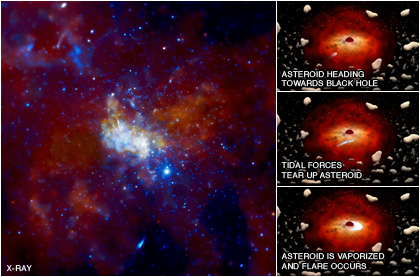
The Chandra Team are no "flash in the pan" a long term contributor to COS, report on a new study suggests mysterious X-ray flares caught by Chandra may be asteroids falling into the Milky Way's giant black hole.

Announcing the reboot of a long defunct blog: the Astronomy Word of the Week (AstroWoW). Starting with the letter 'A', this week's entry is brought to you by the word 'aberration'.

Starry Critters reports on Sea mon­sters, birds and mys­tic moun­tains hiding in this highly detailed infrared image of the star-making Carina Neb­ula from ESO’s Very Large Telescope.


For the A-Z of all things space ZME Science looks at the longest drought on record - 600 million years on Mars. Others have been playing with water droplets on the International space station. Water droplets orbiting a knitting needle - take a look!


Armagh Planetarium brings us the legend - centuries ago a Chinese official named Wan Hu attempted to visit the Moon. His spacecraft was a large wicker chair to which were fastened 47 large rockets. His underlings rushed forward to light the fuses then retreated. A moment later there was a mighty bang and flash accompanied by thick clouds of smoke. When the smoke had cleared, Wan Hu was gone without a trace. This story is repeated time and time again but is it true?

Finally here at AARTScope (below also) I cover one of the southern beauties that many of you eclipse hunters, planning a pilgrimage to Australia for the Solar Eclipse in November, will want to take a look at. The ESO released last week a new image of the Gabriela Mistral Nebula NGC 3324.


The Carnival of Space is a community of interest blog carnival bringing together the best and brightest Astronomy & Space Blogs at a single point in space and time (commonly referred to as a web address) each week. Previous episodes can be found here. If you run an astronomy or space science blog you can contact carnivalofspace @ gmail.com to be added to the editorial circulation list.

[Photo credits listed in the relevant articles]

Monday, February 6, 2012

The Southern Mystery of the Mistral

Image Credit: ESO

Everyone loves a mystery, and this mystery involves star formation and the Nobel Prize winning Chilean Poet, Verschatse. When you look at this image, and the one below, NGC 3324 looks like mysterious cave, luring you closer to come in and have a look around.

One of the interesting aspects of astronomy is the distribution of the world's telescopes, many of which (along with the broader population of the planet) are northern hemisphere based. So the people of Chile were well qualified to play the "what does it look like" game and noticed that the dusty edge bore a stark resemblance to the profile of the Chilean Poet Daniel Verschatse and the name of the "Gabriela Mistral Nebula" seemed appropriate.

The stunning star forming region around Eta Carina is where NGC 3324 can be found - not far from the southern cross. For those from the north, especially those honored guests visiting us in November for the Solar eclipse, this stunning video will assist you to get your bearings.
Loading player...

Video Credit: ESO/Nick Risinger (skysurvey.org)/Digitized Sky Survey 2. Music: John Dyson (from the album Moonwind)

The European Southern Observatory has just released a new image of NGC 3324. Utilizing the power of the Wide Field Imager on the MPG/ESO 2.2-metre telescope at ESO's La Silla Observatory (Chile), it reveals many dark features in NGC 3324.

The ESO describes this stunning region of Star formation as follows:

"Dust grains in these regions block out the light from the background glowing gas, creating shadowy, filigree features that add another layer of evocative structure to the rich vista."

[Not sure who wrote that but some Chilean wine company should sign them up to write their wine labels]

The ESO continues ....
"NGC 3324 is located in the southern constellation of Carina (The Keel, part of Jason’s ship the Argo) roughly 7500 light-years from Earth. It is on the northern outskirts of the chaotic environment of the Carina Nebula, which has been sculpted by many other pockets of star formation. A rich deposit of gas and dust in the NGC 3324 region fuelled a burst of starbirth there several millions of years ago and led to the creation of several hefty and very hot stars that are prominent in the new picture.

Stellar winds and intense radiation from these young stars have blown open a hollow in the surrounding gas and dust. This is most in evidence as the wall of material seen to the centre right of this image. The ultraviolet radiation from the hot young stars knocks electrons out of hydrogen atoms, which are then recaptured, leading to a characteristic crimson-coloured glow as the electrons cascade through the energy levels, showing the extent of the local diffuse gas. Other colours come from other elements, with the characteristic glow from doubly ionised oxygen making the central parts appear greenish-yellow".


NGC 3324, because of its proximity deep in the southern skies, has not been widely photographed by astronomers. Australian amateurs have previously turned their attention to this stunning target with long duration stacked exposures. Perhaps the finest example is Brad Moore's study of the Gabriel Mistral Nebula. Brad is the MD of iTelescope.net and is regularly sought after as a speaker for his astrophotography and remote telescope management skills.

Brad's image consists of 36 Hours of exposure time in narrowband - 8Hrs Oiii, 19Hrs Ha & 9Hrs Sii color mapped to RGB. It is a testament to the fact that so long as you have the field of view even a 12.5 inch amateur scope can pull in the photons if you are patient enough.
Image Credit: Gabriela Mistral Nebula - Brad Moore

What a beautiful part of the universe - it doesn't take a Nobel Prize to know that's a cave I'd love to hide in!

The year 2012 marks the 50th anniversary of the founding of the European Southern Observatory (ESO). ESO is the foremost intergovernmental astronomy organisation in Europe and the world’s most productive astronomical observatory. It is supported by 15 countries: Austria, Belgium, Brazil, the Czech Republic, Denmark, France, Finland, Germany, Italy, the Netherlands, Portugal, Spain, Sweden, Switzerland and the United Kingdom. ESO carries out an ambitious programme focused on the design, construction and operation of powerful ground-based observing facilities enabling astronomers to make important scientific discoveries. ESO also plays a leading role in promoting and organising cooperation in astronomical research. ESO operates three unique world-class observing sites in Chile: La Silla, Paranal and Chajnantor.

Wednesday, February 1, 2012

433 Eros at Opposition - Share the love!


There is a great Citizen science initiative going on with calculation of the "Parallax View" of 433 Eros at opposition from different places on earth to help re-measure the size of the solar system.

See Dr Pamela Gay's new Cosmoquest website for details.

Also you can submit your own measurements (similar to the above) here.

Image 1: 433 Eros from Nerpio in Spain at 02:58 UTC.


Sadly Spain and New Mexico are so far apart there is a bit more than parallax at work here....the second image is from Observatory H06 some 4 hours later, and Eros has also moved in those 4 hrs. The data is still useful as the calculations for the project will take that into account.

Note the plate scale is different due to the different focal lengths and plate scale of the two telescopes. Also I have rotated the New Mexico image 90 degrees to make the position angle of the image roughly the same.
Image 2: 433 Eros from New Mexico at 06:07 UTC.

Search

Custom Search