M78 what a beauty!!! Well as you can see from my previous posts I am quite taken with M78. I think it would be fair to say its on of the “bluest” things in the night sky.
You can see from my previous post, the difference between a 1hr and a three hour exposure and the difference between a 44K JPG and a somewhat higher quality one (900K).
My image processing (and I consider that I have logged enough hours to be good, but still no where near Russell Croman or Tom Davis’ league)…..is as follows:
Calibrate all images with Darks and flats
Use Kernel filter to remove dark and hot pixels
Combine in color channels
Color combine
Export from Maxim DL as a TIFF
Use Levels and curves in Photoshop, according to the 4 Zone Method (Wodaski/Croman)
Remove any remainin hot pixels with healing brush
Reduce size of image and export to JPG
And the finished product I’m sure you would love to see…

My kids asked me what is it called? I said M78! "Yer dad, but doesn't it have a name like a barn owl nebula or something?" So I checked and no it doesn't have a common name. So lets take a closer look.

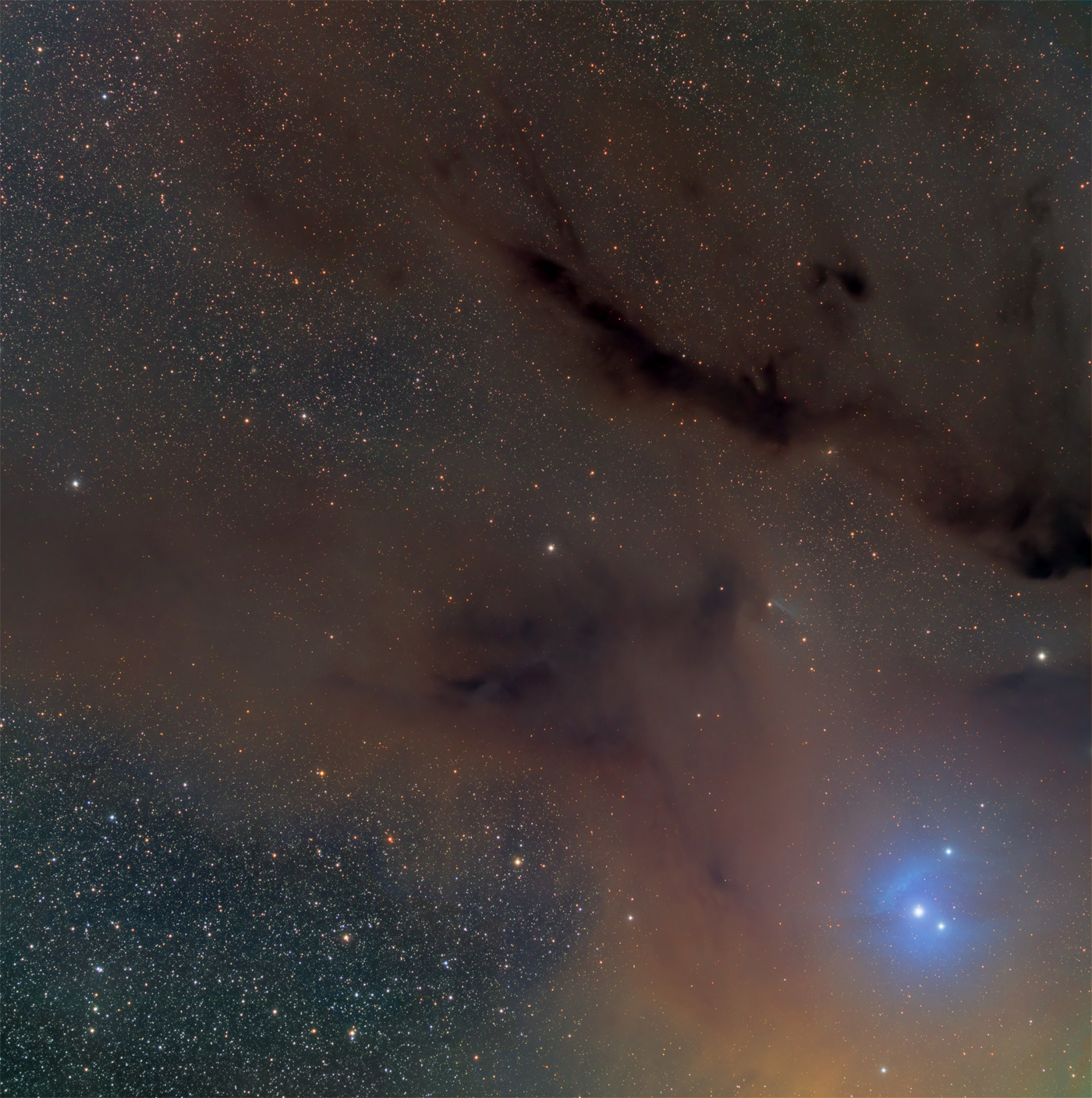
Anyway it does look nice......particularly in
this wide angle shot that made APOD earlier in the year.

 Its a long weekend and I finally got some time to do some image processing and writing.
Eta Carina Nebula is well known in the southern skies as a very large and bright complex nebula, lit up by the star Eta Carina. Even to the naked eye, and certainly even in a wide angle shot from a DLSR on a tripod, the tell-tale reddish blush can be seen even in long exposure star trail images.
Taken from iT30 the 0.5m Planewave at Siding Spring, it includes 5x300 Sec images in each of the Ha, Sii, Oiii and mapped to the "Hubble Pallet" of R=Sii, G=Ha and B=Oiii. As a narrowband image it takes a 3nm "slice" of the light at 672 nm for Sii, 656nm for Ha, and 501nm for Oiii and then we create a false color R-G-B image.
Its a long weekend and I finally got some time to do some image processing and writing.
Eta Carina Nebula is well known in the southern skies as a very large and bright complex nebula, lit up by the star Eta Carina. Even to the naked eye, and certainly even in a wide angle shot from a DLSR on a tripod, the tell-tale reddish blush can be seen even in long exposure star trail images.
Taken from iT30 the 0.5m Planewave at Siding Spring, it includes 5x300 Sec images in each of the Ha, Sii, Oiii and mapped to the "Hubble Pallet" of R=Sii, G=Ha and B=Oiii. As a narrowband image it takes a 3nm "slice" of the light at 672 nm for Sii, 656nm for Ha, and 501nm for Oiii and then we create a false color R-G-B image.
 This image needs some more work as I haven't removed the pixel bleed caused by over exposing the star. Diffraction spikes look nice on an ABG (Antiblooming) Camera, but this was taken on a non-antiblooming camera and needs to be tidied up using some of the tools in the processing package. Given that the Nebula is so large it really requires a two frame mosaic to cover it all, I'll crop it down to the pillars at the bottom.
 Still it gives you an idea of the great imaging that can be achieved by amateurs using the quality tools available at iTelescope.net.
Then comes the clean up of the stars, and everything looks great!
Still it gives you an idea of the great imaging that can be achieved by amateurs using the quality tools available at iTelescope.net.
Then comes the clean up of the stars, and everything looks great!
 Step four is always: Get a good nights sleep and come back and have a fresh look at it in the morning, then subtly tweek some of the parameters. You can stare at an image so long you think that's no better or its not as good as it could be, when in actual fact its absolutely amazing and no-one has ever capture the subject quite that way before.
The finished product is just spectacular!
Step four is always: Get a good nights sleep and come back and have a fresh look at it in the morning, then subtly tweek some of the parameters. You can stare at an image so long you think that's no better or its not as good as it could be, when in actual fact its absolutely amazing and no-one has ever capture the subject quite that way before.
The finished product is just spectacular!