Showing posts with label extrasolar planet. Show all posts

Friday, July 12, 2013

Azure planet a colorful twist

Image Credit: NASA, ESA, M. Kornmesser (Artist impression)

Astronomers using the NASA/ESA Hubble Space Telescope have, for the first time, determined the true colour of a planet orbiting another star. If seen up close this planet, known as HD 189733b, would be a deep cobalt blue, reminiscent of Earth’s colour as seen from space.

Frédéric Pont of the University of Exeter, UK, leader of the Hubble observing programme and an author of a new paper on HD 189733b said:
"This planet has been studied well in the past, both by ourselves and other teams, but measuring its colour is a real first — we can actually imagine what this planet would look like if we were able to look at it directly."

We all have heard the expression "pale blue green dot" as a description of earth, HD 189733b's color is azure which is a very bright blue with almost no reflected green light. So whilst the planet is simlar color to earth from space but that's where the similarities end. This "deep blue dot" is a huge gas giant orbiting very close to its host star.

Image Credit: NASA, ESA, and A. Feild (STScI/AURA)

Azure is sometimes used as an evocative adjective not just a color, the azure waters of your favourite beachside destination, or the tiny azure Kingfisher one of Australia's most stunning birds. Dictionaries defines azure as the color of the clear blue sky or a light purple shade of blue. Whilst astronomers love clear blue skies pointing to a night of great observations, the atmosphere of the azure planet HD189733b is anything but plain sailing on a clear day.

Image Credit: JJ Harrison, Julatten, Qld 2011. Wikipedia Commons

Only this week talented amateur astronomer Emmanuel Conseil trapped this planet in front of its parent star during a transit. Emannuel like many other amateur astronomers regularly collaborate on extra-solar planet transits and submit their data to the TRESCA database. HD189733b has over 90 such observations from astronomers around the world.

Image Credit: HD189733b transit - Emmanuel Conseil

At a distance of 63 light-years from us, this turbulent alien world is one of the nearest exoplanets to Earth that can be seen crossing the face of its star. The planet's atmosphere is scorching with a temperature of over 1000 degrees Celsius, and it rains glass, sideways, in howling 7000 kilometre-per-hour winds.

So the azure blue "seas" here are nothing like the Amalfi coast!

An explanation is provided by Tom Evans of the University of Oxford, UK, first author of the paper:

"We saw the brightness of the whole system drop in the blue part of the spectrum when the planet passed behind its star. From this, we can gather that the planet is blue, because the signal remained constant at the other colours we measured."
The planet's azure blue colour does not come from the reflection of a tropical ocean, but is due to a hazy, turbulent atmosphere thought to be laced with silicate particles, which scatter blue light. Earlier observations using different methods have reported evidence for scattering of blue light on the planet, but these most recent Hubble observations give robust confirming evidence, say the researchers.

Looking out - Looking in!

It is thought that inside the atmosphere the sunsets on HD 189733b could be red. If sodium absorbs red light and dust scatters red light, the atmosphere will redden light shining through it, but will appear blue in reflected light. The colours of Jupiter and Venus are both due to unknown particles within the atmospheres of the planets. Earth looks blue from space because the oceans absorb red and green wavelengths more strongly than blue ones, and reflect the blueish hue of our sky. The shorter blue wavelengths of sunlight are selectively scattered by oxygen and nitrogen molecules in our atmosphere via a process called Rayleigh scattering.

So there we have it an azure blue planet that rains glass - I'll stop right there before I start to think of quirky analogies about what it takes to make glass ceilings come down. ;-)

The new paper, titled "The deep blue colour of HD 189733b: albedo measurements with HST/STIS at visible wavelengths", will appear in the 1 August issue of the journal Astrophysical Journal Letters.

The Hubble Space Telescope is a project of international cooperation between ESA and NASA.

Sunday, July 3, 2011

KOI 256 Transit


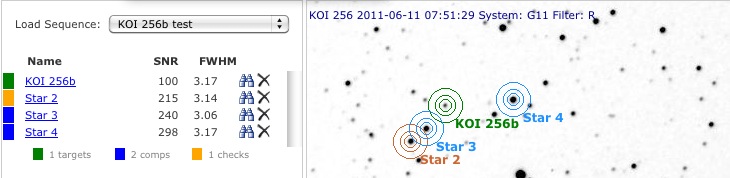
Tonight's run on KOI 256b.

The target is well place for a good long run targeting the 73 minute transit and a good hour of data each side.

The observation plan from Penultimate on my iPad outlines the key ingress and egress points we are looking for. My friends up at Pulkovo are awaiting my next run with anticipation. I was hoping to get the transit on the 29th, but missed it as the Telescope was fully booked. I forgot to put in a reservation ;-).

So any way we are underway and some early clouds have flitted through but all is looking good now as we get into the business end.


Looks like we got it....now to reduce the data and upload to TRESCA.


Astroswanny.

Saturday, June 11, 2011

Live blogging on KOI 256b Transit

UPDATE #10 13:00 UTC
Data uploaded to TRESCA ETD. All in all a fine nights work. The transit occurred earlier than the prediction as we have previously noticed - Thanks to Eugene at Pulkovo Observatory. One pleasing aspect I managed to lift my DQ from 5 to 4 (Data Quality factor).

The predicted mid-point was 2455723.828 TRESCA modelling of the actual mid-point was 2455723.8167.

Good night! Live Blog Ends.

UPDATE #9 12:30 UTC
Data processed about to upload to TRESCA database.


UPDATE #8 11:10 UTC
The brief sharp dip just after the egress corresponds to the images immediately either side of the Meridian Flip. I'll take those outliers out of the finished data. Sometimes before/after a mid image run meridian flip, the scope will slighly mistrack and takes a minute or two to get back into its rythmn.


UPDATE #7 10:50 UTC
The run on the scope has nearly finshed, only three images to go. I have run the data so far through a rough photometery seq, we can clearly see a beautiful transit. Now for the data processing and upload to TRESCA.

UPDATE #6 10:00 UTC
Riversong enters the fray, after Rory's brave stand ...Riversong is Amy's Daughter (spoiler alert), ah I should have written that first....ah well the timelines have been mixed.... ah back to the important matters at hand the egress has been detected. Note: this is still raw data

UPDATE #5 09:10 UTC
The signal to noise is higher tonight as desired.


UPDATE #4 09:00 UTC
Whilst the actual transit has now passed about 30 mins ago the Data is now coming in from the server. After 40% of the run is completed we can clearly see our little friend has indeed passed in front of the Parent star. I am yet to get a reading on the ingress and mid transit time - Later ;-) once we have some more data.


Update #3 8:30 UTC
For those of you asking how the The "Rockling poached in Lemon Grass, Fennel, Mirin, and white wine turned out? D E L I C I O U S!!! [OK, some of you are starting to suspect this is a shameless plug to drive up traffic on my blog.] Seriously... the world is about to stop as our family seeks answers to Riversong's fixation with Dr Who.


UPDATE #2 07:20 UTC
The predicted ingress was 07:14 UTC so the transit should be well under way. We are about 1/3 into the run as the scope has imaged 30 x 120 sec exposures already. These are yet to start downloading to the VPHOT server but should do so soon.


UPDATE #1 06:30 UTC
The run is underway. We are starting well ahead of the transit time tonight so we have a good stable light curve before the transit. A beautiful night! Looks like the moon is not causing any dramas for us.


It's the weekend, and a long one. Thanks to the celebration of the House of Windsor's most senior stateperson's birthday, which ironically is NOT today, nor in fact on Monday either, however celebrated none the less by those uncooperative convicts shipped out 200 years ago. ;-)

The most important person in the house is writing reports, two are studying and one is 27 chapters into Septimus Heap, which had to be purchased before rapid closures of book stores, because apparently there are too many iPADs and eBook readers in the world.

So I thought what else does one do, well there are 8 Kepler Objects of interest transiting every hour today (not all reachable by me.....but some are). So time to roll up the sleeves and make sure I am pulling my weight!!!

I am on kitchen duty as well, so between poaching (as in a frying pan, not from someones private river) a beautiful fillet of Rockling (white fleshed fish) in Mirin, fennel, dill and white wine, I will be doing a live blog for the next three hours on the transit of KOI 256b.

KOI 256b is a very interesting member of the Kepler Objects of Interest (1235 publically published list of transit candidates from the Kepler Space Telescope). It is a very interesting object as its transit is "somewhat" synchronous with its Minima of the variation of its parent star's brightness.

Its a good target (~17mmag) shallow enough to make you carefully plan your run and exposure times, and has the shortest duration of any of the published transit list. So that makes it interesting as you don't have to sit up half the night / or in my case half the afternoon (ah the joys of remote armchair astronomy).

I booked my reservation on GRAS G11. We'll be doing 100 x 120sec images on the target. I did a run last week (60 sec images) and the signal to noise ratio on the target averaged about 63, which was a bit low, for my liking so today I'll go with 120 Sec exposures.

The Pulkovo Observatory and a couple of other amateurs are following this object and I think we have come across some interesting things, so we are working closely to compare our notes, and increasing our data coverage of this little fellow.

Remember as an amateur astronomer I'm not qualified to say "Why" & "How" things happen, I just confine my comments to "What", and "When". The run is under way and Updates will now occur at the top of the Blog. Thanks for joining us for this special event.

Friday, June 3, 2011

Following in Kepler's Footsteps


Carnival of Space...Happy 200th episode, webisode, Bi-centenial (no that's years) or as we say in Australia - 200 Gamer!! Congratulations!!!, what a triumph for social media, education outreach for astronomy and all round great fun.

As its the 200th edition, I thought I better pull out all stops and put together a bumper post!

As an amateur astronomer, I consider myself exactly that, amateur, someone who has the passion, the toys, but hasn't got around to the 4 years of study at Swinburne Astronomy. However the contribution from amateur astronomers is still important, as they can do things at their own pace, share their passion, go after targets of opportunity, targets not likely chased by other professional observatories, and assist the real scientists who know how to do the scary math.

So when the Kepler team published an inviting list of 1235 transit candidates, it was only a matter of time before these "private detectives" started poking around.

Anyone can be involved in the Kepler Hunt, and today I'll cover three different levels where each and everyone of you could assist in bagging a transit, and help share the load of the monumental task of following up the data generated by the Kepler research. By Kepler, of course, I am referring to the space telescope named after 17th century astronomer and mathematician Johannes Kepler, which is currently photographing (continuously) 160,000 stars.

This week, I bagged a transit on one of the 1235 candidates in the publicly released Kepler data. Out of respect for the program, I'll leave the science in its proper place - the TRESCA ETD (Exoplanet Transit Database).


The importance of this is quite interesting as the target has a 6 hour transit, and a thirty day orbit, which means that the transit is only visible to earth based telescopes three times a year.....the next window is in August. The only people likely to pick up what is, lets be honest, probably a fairly low value target, is the amateur community. However ....... data is data!!

Given the number of multiple planet systems and other crazy configurations discovered so far, a single hot Jupiter crossing near the equator every 30 days is possibly - completely boring. However for an Amateur - a real test of skill, patience and sense of accomplishment and involvement in the program.

The challenges of this target were interesting:
1) The transit was 6 hours long, almost impossible to get a complete transit lightcurve - So I focused on the Egress which was well positioned.

2) The depth of the transit was a bit of an unknown - It looked big in the Kepler Data lightcurve in the MAST database.....but as Kepler is a space telescope there is no atmospheric extinction to worry about, they don't use comparison stars and they measure direct flux variation in parts per million - hard to know what that would look like down here. So I took a punt and picked the biggest depth, in the best position I could find on the given night - KOI 189b.

3) There were no AAVSO reference stars in the FOV. In exoplanet research there is much less reliance on cataloged reference stars as the photometry is based more on total flux, compensation for airmass, extinction, and camera noise etc. However basic differential photometery can still produce reasonable results, as my recent run on HAT-P-3b confirmed.


4) towards the end of the run, the Moon rose and messed around with my sky glow background values, causing some additional noise in the signal.

All good learnings for the future.

Bagging Transits
The are three levels of involvement in Kepler exoplanet research: Citizen science, Serious Amateur, Guest Observer. (I guess there is a fourth being on the actual Kepler Team).


Zooniverse has teamed up with the Kepler Team to provide yet another element to their hugely popular Citizen Science program, first pioneered by Galaxy Zoo. A veritable army of 429,000 members have an account, some look at the Kepler light curves, classify the star type and use an adjustable rectangular overlay to highlight any observed transits. This is a lot of fun and teaches you a lot about the many different star types and has the mandatory comment, share and chat functions. Every now and then they will throw in a known target and cheer you on for correctly identifying it. In addition to the 80 odd newly discovered transits, hundreds of eclipsing binaries have also been identified.

Join up today and bag a transit yourself!

Serious Amateurs participate in exoplanet research and contribute to the TRESCA ETD. This work was pioneered by legendary amateur Exo-hunter Bruce Gary, who deveolped somewhat of a cult following. Finding it difficult to maintain a growing database of Lightcurves, he teamed up with the Czech Astronomical Society who already had a scalable repository for light curves - and it even deals with the Scary Math for you!!!

Kepler Guest Observer Program is for professional astronomers to submit proposals for new observations that sit outside the core Kepler Mission Goals:
* Provide a statistically significant value for the frequency of Earth-size and larger planets in and near the habitable zone;
* Characterize the size and orbital distributions of such planets;
* Identify correlations between the presence and characteristics of planetary systems with stellar properties of the host star.


The Kepler Team maintain a database of lightcurves in MAST Multimission Archive at Space Telescope Institute. MAST contains all the lightcurves including the "public list" of transit candidates, some of this data is proprietry, and can be made available to guest observers. They publish a list of the 1235 "public targets" that were covered in Boruki et. al. 2011 These are made available for professionals and amateurs alike, to formulate their own research and leverage the wider Astronomy community.

(note: earth sized planets are so tiny their transits are only a few 10,000ths of a magnitude and are out of reach for earth based amateur scopes)

Collaborative efforts like Zooniverse / Planethunters.org is one such example of the broader astronomy community using this data.

For me, my target KOI 189b, was listed as "No Obs" in the comments field, certainly sounded like an invitation ;-)

So here's to the Carnival of Space that keeps driving my interest to new and higher levels of involvement, in the great unanswered questions.

The work pays off, sometimes in very unexpected ways. This FMO flew through the field of view as I was doing some test images mid transit about an hour and a half before I got serious about the Egress. At 600 arcsecs/min its possibly a Geo-Stationary satellite, but a little unusual to say the least.


Happy 200th - Carnival of Space!!!

Wednesday, December 1, 2010

ESO all steamed up about GJ 1214b


ESO today announced a stunning breakthrough in Spectrophotometery with a world first - analysis of the composition of a "super-Earth" exo-planet's atmosphere,...... and its steamy or hazy.

GJ 1214b is the first "super-Earth" to have its atmosphere analysed by astronomers and possibly water, in the form of steam, is the most likely explanation for what was found in the atmosphere.

In 2007 on Astronomy Cast, Dr Pamela Gay, talking about exo-planet research predicted "we will soon find our own little waterworld just waiting for a b-grade movie to be filmed on it." Well, waterworld it maybe, but this one has alot more steam than an Alfred Hitchcock shower!!!

On the 19th of November 2010 astrophysicists passed a major milestone with the discovery of the 500th exo-planet. An exo-planet is an extrasolar planet that orbits a star outside our own solar system. What are these planets, how do we find them, what are they made up of and how do we understand them?

A super-Earth is a rocky planet of 5-10 earth masses. These are of particular interest to astronomers as their likely orbits can fall in the potentially habitable zone around its parent star, where water could exist as a liquid.

Scientists use three primary methods to find planets around other stars, a radial velocity method, watching for micro-lensing events, and observing transits where the planet interrupts the line of sight causing its host star to dim.

GJ 1214b was discovered in 2009 on the HARPS instrument on ESO's 3.6m telescope in Chile. Initial suspicitions that GJ 1214b's density was too low to be composed only of solid material, therefore being a good candidate for an atmosphere, have now been confirmed by an international team of astronomers using the FORS instrument on the ESO's VLT (very large telescope).
Researchers Jacob Bean (Harvard Smithsonian Center for astrophysics), Eliza Miller-Ricci Kempton (Georg-August-Universitat, Germany) and Derek Homeier (University of California) have co-authored a paper to be published in tomorrow's edition of Nature explaining their detailed research.

"This is the first super-Earth to have its atmosphere analysed. We've reached a real milestone on the road to characterizing these worlds," said Bean.

The team were looking for one of three possible scenarios:
  • a small rocky planet shrouded in water/steam
  • an atmosphere of hydrogen obscured by dense high clouds and haze
  • a mini neptune like planet with a small rocky core and a rich hydrogen atmosphere
The observational method was highly complex and noted that there were no significant features in the specrum between 780 and 1000 nM ruling out the possibility of a rich hydrogen atmosphere.

Astronomer's use spectral analysis to determine the make up of an exo-planet's atmosphere. By monitoring the light of the parent star and looking for absorbtion lines at specific frequencies during the transit of an exo-planet, they compare the normal/reference light of the star for any differences and changes.

"Although we can't yet say exactly what that atmosphere is made of, its an exciting step forward to be able to narrow down the options for such a distant world to either steamy or hazy" said Jacob Bean. "Follow-up observations in longer wavelengths are required to determine which of these atmospheres exists on GJ 1214b".

Photo Credit ESO/L Carcada

Search

Custom Search