
Data uploaded to TRESCA ETD. All in all a fine nights work. The transit occurred earlier than the prediction as we have previously noticed - Thanks to Eugene at Pulkovo Observatory. One pleasing aspect I managed to lift my DQ from 5 to 4 (Data Quality factor).
The predicted mid-point was 2455723.828 TRESCA modelling of the actual mid-point was 2455723.8167.
Good night! Live Blog Ends.
UPDATE #9 12:30 UTC
Data processed about to upload to TRESCA database.

UPDATE #8 11:10 UTC
The brief sharp dip just after the egress corresponds to the images immediately either side of the Meridian Flip. I'll take those outliers out of the finished data. Sometimes before/after a mid image run meridian flip, the scope will slighly mistrack and takes a minute or two to get back into its rythmn.

UPDATE #7 10:50 UTC
The run on the scope has nearly finshed, only three images to go. I have run the data so far through a rough photometery seq, we can clearly see a beautiful transit. Now for the data processing and upload to TRESCA.
UPDATE #6 10:00 UTC
Riversong enters the fray, after Rory's brave stand ...Riversong is Amy's Daughter (spoiler alert), ah I should have written that first....ah well the timelines have been mixed.... ah back to the important matters at hand the egress has been detected. Note: this is still raw data
UPDATE #5 09:10 UTC
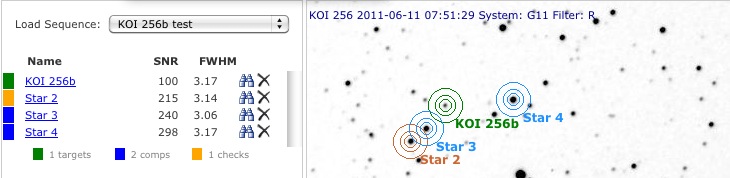
The signal to noise is higher tonight as desired.
UPDATE #4 09:00 UTC
Whilst the actual transit has now passed about 30 mins ago the Data is now coming in from the server. After 40% of the run is completed we can clearly see our little friend has indeed passed in front of the Parent star. I am yet to get a reading on the ingress and mid transit time - Later ;-) once we have some more data.

Update #3 8:30 UTC
For those of you asking how the The "Rockling poached in Lemon Grass, Fennel, Mirin, and white wine turned out? D E L I C I O U S!!! [OK, some of you are starting to suspect this is a shameless plug to drive up traffic on my blog.] Seriously... the world is about to stop as our family seeks answers to Riversong's fixation with Dr Who.

UPDATE #2 07:20 UTC
The predicted ingress was 07:14 UTC so the transit should be well under way. We are about 1/3 into the run as the scope has imaged 30 x 120 sec exposures already. These are yet to start downloading to the VPHOT server but should do so soon.

UPDATE #1 06:30 UTC
The run is underway. We are starting well ahead of the transit time tonight so we have a good stable light curve before the transit. A beautiful night! Looks like the moon is not causing any dramas for us.

It's the weekend, and a long one. Thanks to the celebration of the House of Windsor's most senior stateperson's birthday, which ironically is NOT today, nor in fact on Monday either, however celebrated none the less by those uncooperative convicts shipped out 200 years ago. ;-)
The most important person in the house is writing reports, two are studying and one is 27 chapters into Septimus Heap, which had to be purchased before rapid closures of book stores, because apparently there are too many iPADs and eBook readers in the world.
So I thought what else does one do, well there are 8 Kepler Objects of interest transiting every hour today (not all reachable by me.....but some are). So time to roll up the sleeves and make sure I am pulling my weight!!!
I am on kitchen duty as well, so between poaching (as in a frying pan, not from someones private river) a beautiful fillet of Rockling (white fleshed fish) in Mirin, fennel, dill and white wine, I will be doing a live blog for the next three hours on the transit of KOI 256b.
KOI 256b is a very interesting member of the Kepler Objects of Interest (1235 publically published list of transit candidates from the Kepler Space Telescope). It is a very interesting object as its transit is "somewhat" synchronous with its Minima of the variation of its parent star's brightness.
Its a good target (~17mmag) shallow enough to make you carefully plan your run and exposure times, and has the shortest duration of any of the published transit list. So that makes it interesting as you don't have to sit up half the night / or in my case half the afternoon (ah the joys of remote armchair astronomy).
I booked my reservation on GRAS G11. We'll be doing 100 x 120sec images on the target. I did a run last week (60 sec images) and the signal to noise ratio on the target averaged about 63, which was a bit low, for my liking so today I'll go with 120 Sec exposures.
The Pulkovo Observatory and a couple of other amateurs are following this object and I think we have come across some interesting things, so we are working closely to compare our notes, and increasing our data coverage of this little fellow.
Remember as an amateur astronomer I'm not qualified to say "Why" & "How" things happen, I just confine my comments to "What", and "When". The run is under way and Updates will now occur at the top of the Blog. Thanks for joining us for this special event.


