Showing posts with label ceres. Show all posts

Saturday, July 16, 2011

Fiction comes to life, as Dawn approaches orbit around Vesta

Image Credit: Gregory J. Whiffen JPL

I'm not sure what is more impressive - the scientific feat, or the sense of humor with which it has been carried out.

This excellent (and funny) video outlines the development of the Dawn mission control center and the use of an Ion Drive in the mission, and where the Ion drives first ....ah... connects with our scientific cultural heritage. [Star Trek Movies]
The actual concept of ion propulsion was first put to paper in 1911 by Konstantin Tsiolkovsky with Harold Kaufman testing the first prototype drive in 1959 after decades of research. Ion Drives have been used in a number of recent missions including Deep Space 1 and Hayabusa.

Image Credit: NASA JPL Dawn Mission


Chief Engineer Marc Rayman like all good Trekkies keeps a "ship's log". On July 13th Dawn was about 23,000 kilometers (14,000 miles) from Vesta, and approaching it at 37 meters per second (83 mph). Dawn remains on course as it continues ion thrusting to reach its first science orbit this weekend.

The Dawn spacecraft, on its way to Vesta then Ceres, will be the first spacecraft to enter an orbit around a main belt asteroid, it carries a scientific payload, with four experiments.

- Framing camera for guidance
- Infrared and visual spectrometer
- Gamma ray and Neutron spectrometer
- Gravity science

Mission controllers are looking for return of the following data:

1) Images of Vesta and Ceres in three colors and black and white

2) Full surface with mapping spectrometer in three bands, 0.35 to 0.9 micron, 0.8 to 2.5 micron and 2.4 to 5.0 micron

3) Neutron and gamma ray spectra to produce maps of the surface elemental composition of each asteroid, including the abundance of major rock-forming elements (O, Mg, Al, Si, Ca, Ti, and Fe), trace elements (Gd and Sm), long-lived radioactive elements (K, Th, and U), and light elements such as H, C, and N, which are the major constituents of ices.

4) Radio tracking to determine mass, gravity field, principal axes, rotational axis and moments of inertia.

Scientists hope to learn about the makeup and composition of main belt asteroids, study their elements, identify any metals, trace elements and ice.

Recently main belt asteroid Scheila exhibited a brief cometary outburst (photos here) providing further possible evidence that some asteroids could carry significant amounts of ice.

The ten Kilogram GRaND - Gamma Ray and Neutron Spectrograph, perhaps the most complex of the instruments, will detect what radiates off the asteroid as it is hit by cosmic waves. The Mission "Splat Diagram" explains the different forms of radiation that are emitted and how this is captured by the instrument.

Based on the data the mission controllers hope to learn more about how the asteroids in the belt were formed.

Image: Data control interface for Ion Drive.


The data could also be also very useful, it we ever decide to paint an asteroid in an attempt to divert its path over a number of years. It would be good to know which color to use, and any additives. ;-)

Congratulations once again to the NASA JPL team.

UPDATE: July 16. Dawn has successfully entered orbit around Vesta.

Friday, March 11, 2011

Carnival of Space 188.

image credit - incasinoout777 at good time webshots
Image Credit: incasinoout777 at Goodtime webshots (Ferris Wheel in an earthquake).

The inexorable subduction of the pacific plate regularly brings earthquakes to Japan. We often pause briefly to admire the readiness and civil defense response that shows their preparation and courage to deal with such events.

Today the world stops to catch its breath and stand with Japan in the face of this monster earthquake and tsunami. It brings the realization to all of us, the tenuous hold we have on life, on this our "third rock from the sun".

Plate tectonics allow life to exist, brings us our rich volcanic soils, and yet can take life with such savagery that stuns us, and causes us to ponder.

To the people of Japan, and all our friends in the astronomy community in Japan -
我々の思いはあなた達と共にあります

Welcome to this week's Carnival of Space #188.

I am constantly amazed that up to 60-90% of traffic to my own blog comes from mobile devices, in the spirit of that, today I will provide a QR Scan code to each of the Home Pages of our intrepid bloggers. Download your preferred QR Scan code app from your handheld device provider and away you go.

So here we go its Carnival Time!!!!
In keeping with the reflective tone, Steve Tilford's personal tribute on the passing of his friend and mentor Dr Jim Elliot, covers his life, his philosophy and great discoveries (eg. he was on the team that discovered the rings of Uranus). Steve's detailed coverage has collected some thoughts and reflections from other scientists about the legacy Dr Jim has left us all. Read it, and ask yourself the question - what legacy will I leave?


Steve's Astro Corner QR Scan Code.


Vega 0.0 also takes some time to reflect - on pioneer astronomer Friedrich Wilhelm August Argelander's work and covers "método Argelander"(Argelander method) for observing variable stars. This article is in Spanish, which gives you a second reason to try out online translation tools this week.


Vega 0.0 Blog QR Scan Code.


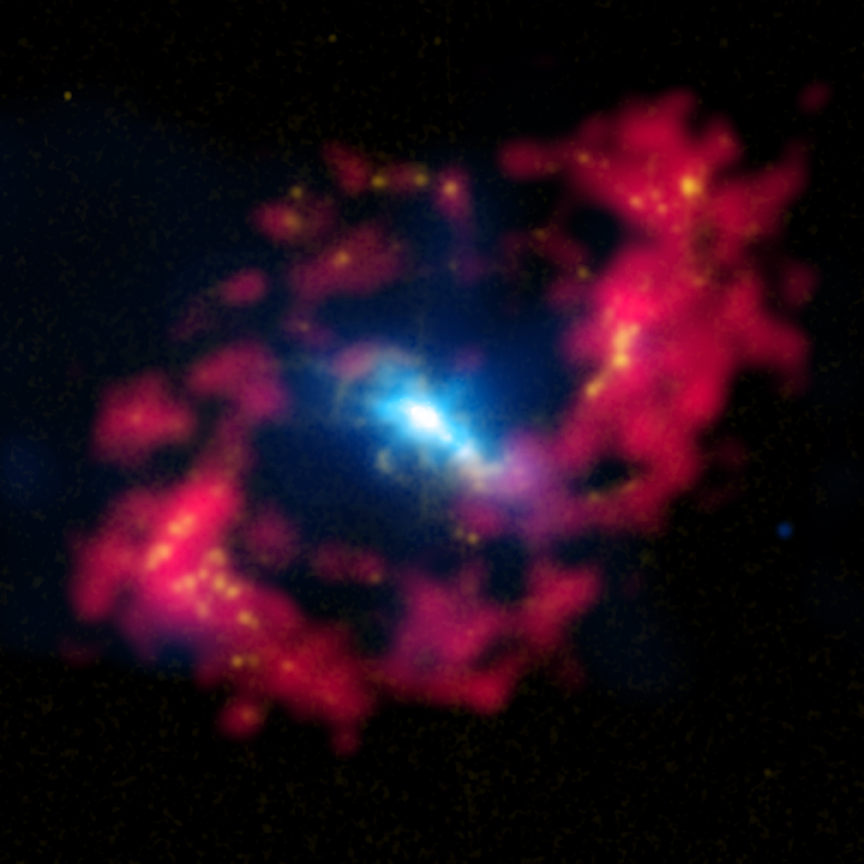
Chandra Blog this week features a stunning image of NGC 4151, a spiral galaxy with an actively growing supermassive black hole at its center. The structure has been dubbed "The Eye of Sauron" by astronomers due to its resemblance to the character in "The Lord of the Rings" movies. The image is a composite of X-ray, Ha and Radio spectrum. Read the amazing story of how this image was compiled.


Chandra Blog's QR Scan Code.


Next Big Future reports this week on Russia's plans for a megawatt nuclear space reactor and using it for space tugs and Mars missions. Brian continues the "powering up" theme with VASIMR's plans for the next 5-10 years and getting up to 1-6 megawatt missions.

Sounds like they'll have enough power budget for blutooth .......everything is better with Blu......(yes, yes we know)[Bigbang Theory].

Brian also updates us on details of the minimag Orion for near term interstellar missions. The full paper is available for free online.


Next Big Future QR Scan Code.


AstroBlogger reports on the post paper forensics of claims that fossil bacteria have been found in a meteorite. It's just magnesium sulfate nanobelts folks.


AstroBlogger QR Scan Code.


TheSpacewriter continues on the meteorite story and takes on the journalistic ethics of those who ran with the meteorite-life story last week and didn't bother to check the facts. Carolyn is much more qualified than I am to say what you can and can't do in 72 point font.


TheSpaceWriter QR Scan Code


At Cheap Astronomy, Steve takes us to places far, far away and talks in one of his well respected podcasts about about dwarf galaxies - large and small.


Cheap Astronomy QR Scan Code.


At WeirdWarp, Chris tries to lift the self esteem of asteroids by suggesting more useful things for them to do than killing dinosaurs. Arriving on an asteroid second after someones been there for a fit-out seems perfectly logical. Think big people!

Maybe we CAN send the telephone sanitizers first. [Hitchhiker's Guide to the Galaxy].


WeirdWarp QR Scan Code


Now you might think that Asteroids have a self esteem problem, but what about Ceres. Astropixie puts Ceres "on the couch" for a session on why Pluto had it coming!! [Warning: contains astronomy terms that might not be suitable for astronomers young enough to not know what a ...hmm ..."two body problem" is"].


Astropixie QR Scancode.


As opposed to being demoted, what if you never made it in the first place? A brown dwarf, about 75 light-years from Earth, has hit a new low. In fact, its temperature is so low that it is about the same temperature as the cup of tea sitting on Ian's desk. Discovery News asks the question: Stellar-Failure or just misunderstood?


DiscoveryNews QR Scan Code.


Nancy, Senior editor of Universe Today features an article on the Catalin Fus image of STS-133 mission to the ISS passing infront of the sun past the currently active sunspot region.


Universe Today QR Scan Code.


So, as we bring the Carnival of Space 188 to a conclusion, mindful of the powerful forces at work on our planet, in our galaxies, and yes even in our failed stars, lets use this time of confronting disaster for personal relfection on the legacies that have been left by others and the ones we might leave.

I leave you with a lovely image of M106 taken by John Nunn this week on my telescope.


Astroswanny's AARTScope Scan Code.


The Carnival of Space is a community of interest blog carnival bringing together the best and brightest Astronomy & Space Blogs at a single point in space and time (commonly referred to as a web address) each week. Previous episodes can be found here. If you run an astronomy or space science blog you can contact carnivalofspace@gmail.com to be added to the editorial circulation list.

Search

Custom Search