Monday, May 16, 2011

Comet Elenin in "oncoming traffic"!!!


Update 23/5/2011
The moon is now wanning and I have re-visited Elenin on the 23rd to see how it is after the moon has passed through. This color composite image is stacked once to create a star layer, and again for movement of the comet, to get the coma nice and tight. The two layers are combined in photoshop with a feathered cutout in the star layer revealing the Comet layer behind. This is the quick and easy way of good color comet photos, given the comet is still pretty faint. The image is a one hour of RGB in 300sec subs, processed in Maxim DL (stack & combine) and Photoshop(curves and layers). If you look carefully you will see Elenin passing a tiny little distant Galaxy.
Enjoy!


Original Post.
The full moon is not the best time to be imaging comets - but what the hell! I had a focal reducer fitted to the planewave this week taking it down to F/4.4 so I had to shoot something to try it out.

Here is the latest image of comet Elenin, May 16th at 2011-05-16 03:54:21 UTC, this time in color. I was processing the images and noticed a couple of asteroids very close which certainly made it a worthwhile exercise, even if the images were a bit noisy from the full moon.

This image is 5 x 300 secs of each color R/G/B color combined. Each image tracked the movement of Elenin, thus trailing the background stars slightly in each color.


Passing in the opposite directions across the plate are Asteroid Zoya (1793) at Mag 15.9 and (7503)1996 VJ38 which appears to have "crossed" the (apparent) path of Elenin perhaps about 8-10 hours before my images photos were taken.

Also when the moon is bouncing around it will often give extra highlights to dust donuts that flats normally remove when its nice and dark.

Enjoy!
Astroswanny

Tuesday, May 3, 2011

Comet Elenin


Here is the latest image of Comet Elenin, trying to sneak past the little blue green planet with out becoming involved in any doomsday conspiracies.

It is expected to be quite a show later in the year, if it survives it's perihelion approach to the sun.

Caught here on May 3rd, its sporting a short tail, at the expected brightness around roughly 13 (I haven't done any specific photometry on it).

Astroswanny

Sunday, March 13, 2011

FS Aur Video

As you all know I have been helping Dr Vitaly Neustroev with his research on FS Aur. This is a very erratic variable star that can vary in magnitude by up to 0.2m over an hour, has a number of interacting periodic cycles, and goes into outburst every 13-15 days.

Whilst this video doesn’t really do justice to all the hardwork and the more subtle variations, it none the less is a bit of fun to show you what we have been looking at.

The timescale is a very rough 1 sec = ~2 days.


Enjoy!!!!

Astroswanny

Friday, March 11, 2011

Carnival of Space 188.

image credit - incasinoout777 at good time webshots
Image Credit: incasinoout777 at Goodtime webshots (Ferris Wheel in an earthquake).

The inexorable subduction of the pacific plate regularly brings earthquakes to Japan. We often pause briefly to admire the readiness and civil defense response that shows their preparation and courage to deal with such events.

Today the world stops to catch its breath and stand with Japan in the face of this monster earthquake and tsunami. It brings the realization to all of us, the tenuous hold we have on life, on this our "third rock from the sun".

Plate tectonics allow life to exist, brings us our rich volcanic soils, and yet can take life with such savagery that stuns us, and causes us to ponder.

To the people of Japan, and all our friends in the astronomy community in Japan -
我々の思いはあなた達と共にあります

Welcome to this week's Carnival of Space #188.

I am constantly amazed that up to 60-90% of traffic to my own blog comes from mobile devices, in the spirit of that, today I will provide a QR Scan code to each of the Home Pages of our intrepid bloggers. Download your preferred QR Scan code app from your handheld device provider and away you go.

So here we go its Carnival Time!!!!
In keeping with the reflective tone, Steve Tilford's personal tribute on the passing of his friend and mentor Dr Jim Elliot, covers his life, his philosophy and great discoveries (eg. he was on the team that discovered the rings of Uranus). Steve's detailed coverage has collected some thoughts and reflections from other scientists about the legacy Dr Jim has left us all. Read it, and ask yourself the question - what legacy will I leave?


Steve's Astro Corner QR Scan Code.


Vega 0.0 also takes some time to reflect - on pioneer astronomer Friedrich Wilhelm August Argelander's work and covers "método Argelander"(Argelander method) for observing variable stars. This article is in Spanish, which gives you a second reason to try out online translation tools this week.


Vega 0.0 Blog QR Scan Code.


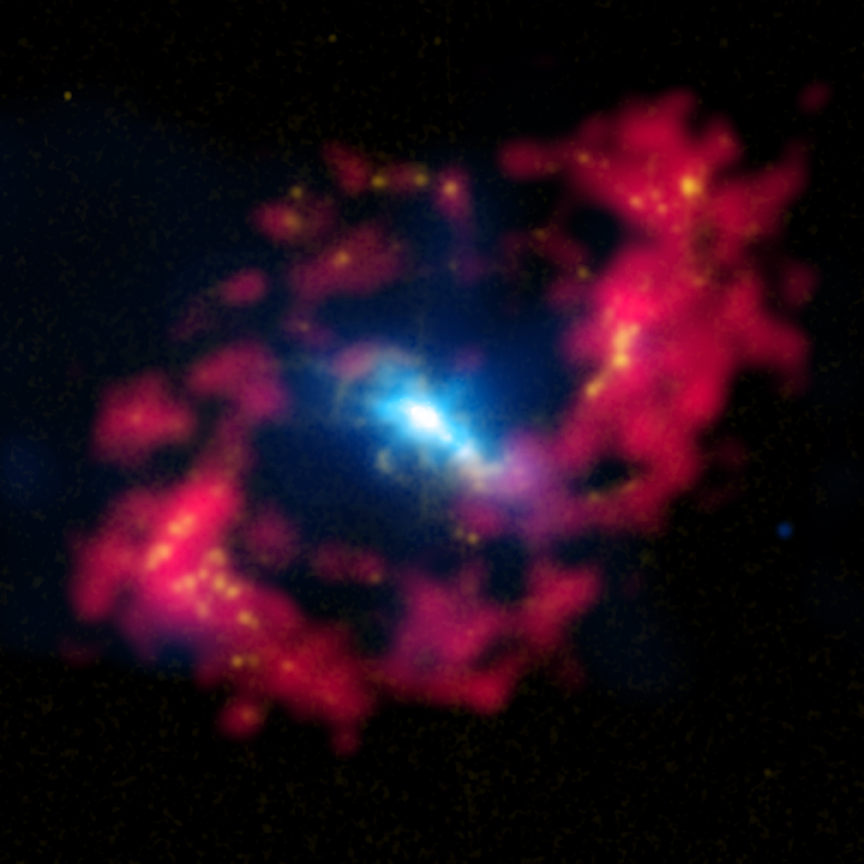
Chandra Blog this week features a stunning image of NGC 4151, a spiral galaxy with an actively growing supermassive black hole at its center. The structure has been dubbed "The Eye of Sauron" by astronomers due to its resemblance to the character in "The Lord of the Rings" movies. The image is a composite of X-ray, Ha and Radio spectrum. Read the amazing story of how this image was compiled.


Chandra Blog's QR Scan Code.


Next Big Future reports this week on Russia's plans for a megawatt nuclear space reactor and using it for space tugs and Mars missions. Brian continues the "powering up" theme with VASIMR's plans for the next 5-10 years and getting up to 1-6 megawatt missions.

Sounds like they'll have enough power budget for blutooth .......everything is better with Blu......(yes, yes we know)[Bigbang Theory].

Brian also updates us on details of the minimag Orion for near term interstellar missions. The full paper is available for free online.


Next Big Future QR Scan Code.


AstroBlogger reports on the post paper forensics of claims that fossil bacteria have been found in a meteorite. It's just magnesium sulfate nanobelts folks.


AstroBlogger QR Scan Code.


TheSpacewriter continues on the meteorite story and takes on the journalistic ethics of those who ran with the meteorite-life story last week and didn't bother to check the facts. Carolyn is much more qualified than I am to say what you can and can't do in 72 point font.


TheSpaceWriter QR Scan Code


At Cheap Astronomy, Steve takes us to places far, far away and talks in one of his well respected podcasts about about dwarf galaxies - large and small.


Cheap Astronomy QR Scan Code.


At WeirdWarp, Chris tries to lift the self esteem of asteroids by suggesting more useful things for them to do than killing dinosaurs. Arriving on an asteroid second after someones been there for a fit-out seems perfectly logical. Think big people!

Maybe we CAN send the telephone sanitizers first. [Hitchhiker's Guide to the Galaxy].


WeirdWarp QR Scan Code


Now you might think that Asteroids have a self esteem problem, but what about Ceres. Astropixie puts Ceres "on the couch" for a session on why Pluto had it coming!! [Warning: contains astronomy terms that might not be suitable for astronomers young enough to not know what a ...hmm ..."two body problem" is"].


Astropixie QR Scancode.


As opposed to being demoted, what if you never made it in the first place? A brown dwarf, about 75 light-years from Earth, has hit a new low. In fact, its temperature is so low that it is about the same temperature as the cup of tea sitting on Ian's desk. Discovery News asks the question: Stellar-Failure or just misunderstood?


DiscoveryNews QR Scan Code.


Nancy, Senior editor of Universe Today features an article on the Catalin Fus image of STS-133 mission to the ISS passing infront of the sun past the currently active sunspot region.


Universe Today QR Scan Code.


So, as we bring the Carnival of Space 188 to a conclusion, mindful of the powerful forces at work on our planet, in our galaxies, and yes even in our failed stars, lets use this time of confronting disaster for personal relfection on the legacies that have been left by others and the ones we might leave.

I leave you with a lovely image of M106 taken by John Nunn this week on my telescope.


Astroswanny's AARTScope Scan Code.


The Carnival of Space is a community of interest blog carnival bringing together the best and brightest Astronomy & Space Blogs at a single point in space and time (commonly referred to as a web address) each week. Previous episodes can be found here. If you run an astronomy or space science blog you can contact carnivalofspace@gmail.com to be added to the editorial circulation list.

Saturday, February 19, 2011

Pirates in Space!!!!


In a week where my son was playing Pirates of the Carribean on Cello in his orchestra, what better thing to do than join Dr Marleen Bryan on her popular “Space Pirates” radio show.

I shared a most enjoyable 45 minutes, on the popular Astronomy.fm radio show covering topics as diverse as Social Media in Astronomy, Variable star photometery, the GRAS telescopes and specifically - variable star FS Aur.

Astronomy FM is a great community numbering several thousand people, and have great podcasts and regular live broadcasts, and great astrophotography competitions.

As an online amateur astronomer, Astronomy.FM is part of the inner circle of great resources available.

If you would like to catch up on the podcast click here.

Peter Lake

Saturday, January 29, 2011

Open Season on FS Aur !!!!


Like duck hunting, Variable Stars have their "Seasons" also. A season being where the variable star in question is in the optimal position for "shooting with CCDs" ie observable for most of the night. FS Aur is a Cataclysmic Variable rising in the early evening, and in the current northern winter, its visable for a good 6-7 hours a night. Thus its "in season".

FS Aur is one of the strangest and complex objects in the extensive variable star family. (See also Steve's excellent article elsewhere in today's Carnival of Space.) It is thought to be a magnetic white dwarf binary CV with a third object acting on it in a circumbinary orbit. (Tovmassian et al., 2010)

Now its in season - astronomers want answers. When they want answers they often leverage the collective effort of the American Association of Variable Star Observers (AAVSO), to muscle up some more observations and data.

FS Aur has a number of photometric and spectroscopic cycles going on. On top of this it goes into outburst about every 12-15 days. The outburst period is so short (2-3 days) it has been regularly missed in the past - so this season Dr Neustroev has rallied a special effort. For the first time, members of the AAVSO will map the entire 15 day outburst cycle, several, hopefully a good number of times.

Dr Vitaly Neustroev is the University Researcher (Yliopistotutkija) at the University of Oulu, Finland and he is a key reseacher on FS Aur, working hard to better understand its erratic behaviour. Visit the observing campaign page here, and also follow on (Twitter).

I like following Cataclysmic Variables, after catching Simostronomy fever, and I have been a regular on FS Aur since Dr Neustroev's call to action.

During the past few weeks FS Aur has been dancing away with a little periodic wobble at about 15.9 with the odd subtle change in brightness, then on the 22nd it went really dull to 16.2 then literally within 24-36 hours it popped to Magnitude 14.3 on the 24th, and then grew to about 14.035 throughout the day.

In my image from the 24th, FS Aur can be seen in the Green annulus.

Now take a look at this image on the 22nd. FS Aur can hardly been seen. It is at magnitude 16.2 at its lowest point in its quiescent phase.

So what is going on with FS Aur - Dr Neustroev describes it this way:

“FS Aur is an extremely unusual cataclysmic variable renown for the presence of a variety of uncommon and largely incomprehensible periodic variabilities of brightness and radial velocity. The outlandish peculiarity of FS Aur is the existence of a very coherent photometric period of 205.5 min that exceeds the spectroscopic orbital period of 85.7 minutes by 2.4 times. Such a discrepancy in the photometric and spectroscopic periods is highly unusual for cataclysmic variables.

Based on the short orbital period, FS Aur has been classified as a SU UMa star. Nevertheless, long‐term monitoring of the system by several groups failed to detect any superoutburst in its light curve. The publicly available AAVSO light curve show instead a steady‐cyclic outburst pattern that is more similar to a SS Cyg–type dwarf nova light curve. However, this monitoring reveals an additional, discordant, and very long photometric period of ~900 days. We explain the latter by the result of eccentricity modulation of a close binary orbit induced by the presence of a third body on a circumbinary orbit (Tovmassian et al., 2010).”


So it is indeed a complex beast. This is a little time-series I ran when it was at quiescence.

When variables are in season you can get nice long lightcurves and do time-series analysis and this is very valuable data. Below is the light curve of FS Aur climbing to its peak during the 24th January. The light curve below spans almost continuous/contiguous 6 hours. It is very interesting as it shows quite clearly the erratic nature and massive forces involved in the outburst. (Each measurement is from a 120s image and with a precision of about 0.01-0.03mag.)

I have also submitted some color times-series in BVRI as this is also useful data, more so if I had got it at the peak of the outburst, alas due to weather I missed out. I'll have to wait another 13 days ;-).

Again, about 4hrs of continuous data can only only be gathered "in season".

So this is indeed a fascinating object and could indeed be a new class of object. Only time will tell. AAVSO members are playing an important role in gathering the data to refine the lightcurve. Once the observing campaign is complete we await with interest to see what the astronmers and astrophysicists can tell about what they have learned.

At AARTScope my mission is to "keep creating the sense of anticipation and discovery that keeps scientists asking questions" so if you are an AAVSO member and would like to join the campaign, please do.

Unlike ducks, no variable stars are harmed during "peak season".

Monday, January 10, 2011

FS Aur in quiescence


Hi, here is my latest data of FS Aur in quiescence - it certainly has a nice little wobble going between 15.9 and 16.1.

This time series taken over 30 minutes with one additional measurement in a second run just before a 42mph wind gust closed the roof ;-(.

[Disclaimer: all data was submitted to AAVSO via standard process - this is just a nice little graphic from VPHOT].

Astroswanny.

Search

Custom Search