Monday, December 31, 2012

2012 - That's a Wrap!

Happy New Year to all the Space and Astronomy lovers.

2012 has been a great year and contained many highlights. The most significant was my new found skills in G+ Hangouts thanks to +Fraser Cain and +Scott Lewis mentoring me.

I always try and bring fresh, original and live content at the Astronomy webs.

The highlights of the year were:

5) My article on Astronomy 3.0 was published by the Variable Stars South Newsletter. (Page 14) The newsletter is always an excellent read and can be downloaded in PDF to your tablet of a relaxed read.

4) Hangout on Air coverage of the Comet Hergenrother outburst including an interview with Carl Hergenrother the discoverer of the comet.

3) Asteroid Hunt for OSIRIS-Rex Target Asteroids in front of a live audience at a Learning in the Laneway Session at the Little Mule Cafe in Melbourne.

2) A live outside broadcast of the Transit of Venus from Siding Spring, NSW.

1) A live Exo-planet Transit of Qatar-1-b broadcast in a G+ "Hangout on Air" for #deSTEMber

All in all, its been a great year, thanks for everyone who has visited my blog, over 3000 per month now.

We have had visitors from nearly every continent on earth. I hope you all feel welcome, I have added the Google Translate widget to the Blog this year, and whilst its not always perfect with the many scientific terms we need to cover, I hope that you embrace it as a genuine attempt to relate in your native tongue.

I hope and trust that 2013 will bring you, and those close to you, a happy, prosperous new year that expands your understanding of the Universe around you,and all the players in its magnificent symphony.

Saturday, December 8, 2012

Live Exoplanet Transit of Qatar 1b to celebrate #deSTEMber

Today we bring you a world first.

A live extra-solar planet transit of Qatar-1b.

We are just about to get started. I won't have much time to update the blog as we go but sit back and watch the +Google Plus Hangout on Air feed.

Thanks for those who joined us LIVE. Here is the replay if you couldn't.

Thanks to +Scott Lewis, +Shahrin Ahmad, +Tamara Hudgins for your assistance in a highly successful event.

Ingress

Midtransit data from VPHOT

Past the mid-point

However the "shot of the day" came from the all sky camera itself with a stunning meteor just before the broadcast started.

So the final wrap up - we sorted out the little glitch towards the end, and restarted the scope and captured the last part of the transit ok - PHEW. Here is the reduced data and final lightcurve of the transit.

Also here is the reduced data submitted to TRESCA.

Wednesday, December 5, 2012

Sensational Singapore Photostudy

Taking a brief detour from my usual fare of Astronomy.

Recently I have been exploring the various epub and document publishing "iHouses". There are some very interesting approaches, methods and websites.

Here is my first foray, a photographic study of one of my favorite cities -SINGAPORE!!!!!

There is lots to consider, the tools you use to tell the story, the platform you want to publish on, and what the ultimate purpose is (getting it out there vs revenue). Depending on whether you want to just stick a PDF on your blog with a paypal button, "go Apple" through the iTunes store, or get a company like Bookbaby to go the whole way with ISBN Numbers and distribution channels - there is something for everyone.

This time I'm using the ISSUU Website which seems to have a large user base with a broad range of content.

Let me know what you think.

Astroswanny

Saturday, October 20, 2012

Near Neighbor

Image Credit: (c) Peter Lake - Southern Cross and Pointers - SSO, Cannon 550D SLR

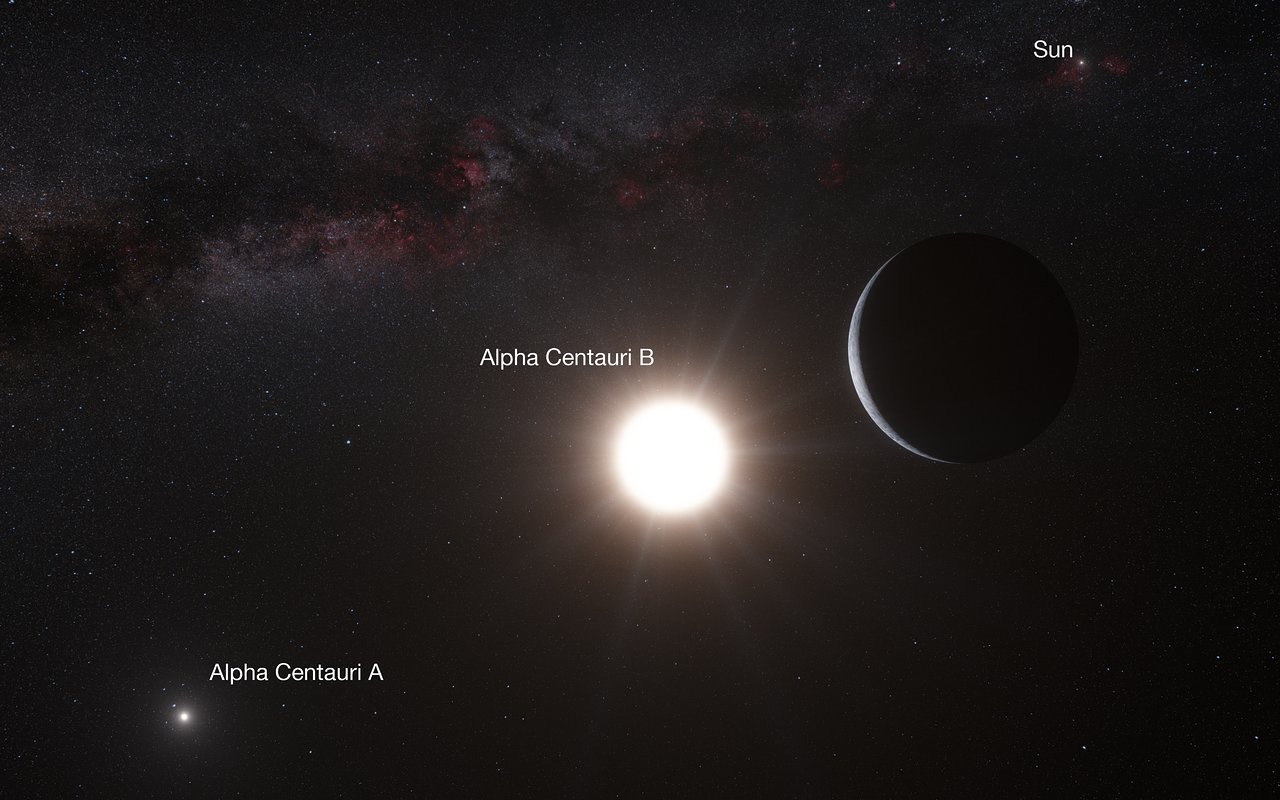
One of the most prominent stars is the southern hemisphere made headlines this week as a team of astronomers, using the ESO Harps Instrument on the 3.6m La Silla observatory in Chile, announced the discovery of an earth sized planet around our closest star.

“Our observations extended over more than four years using the HARPS instrument and have revealed a tiny, but real, signal from a planet orbiting Alpha Centauri B every 3.2 days,” says Xavier Dumusque (Geneva Observatory, Switzerland and Centro de Astrofisica da Universidade do Porto, Portugal), lead author of the paper. “It’s an extraordinary discovery and it has pushed our technique to the limit!”

Image Credit: ESO/L. Calçada/Nick Risinger (skysurvey.org)

Much of the recent news of Extrasolar planet discovery has centered around the Kepler Space Telescope mission, only this week Chris Lintott's & Meg Schwab's team at Planethunters.org also announced the first citizen science discovery of a planet in a 4 star system....come to think of it that has a nice ring to it. ;-)

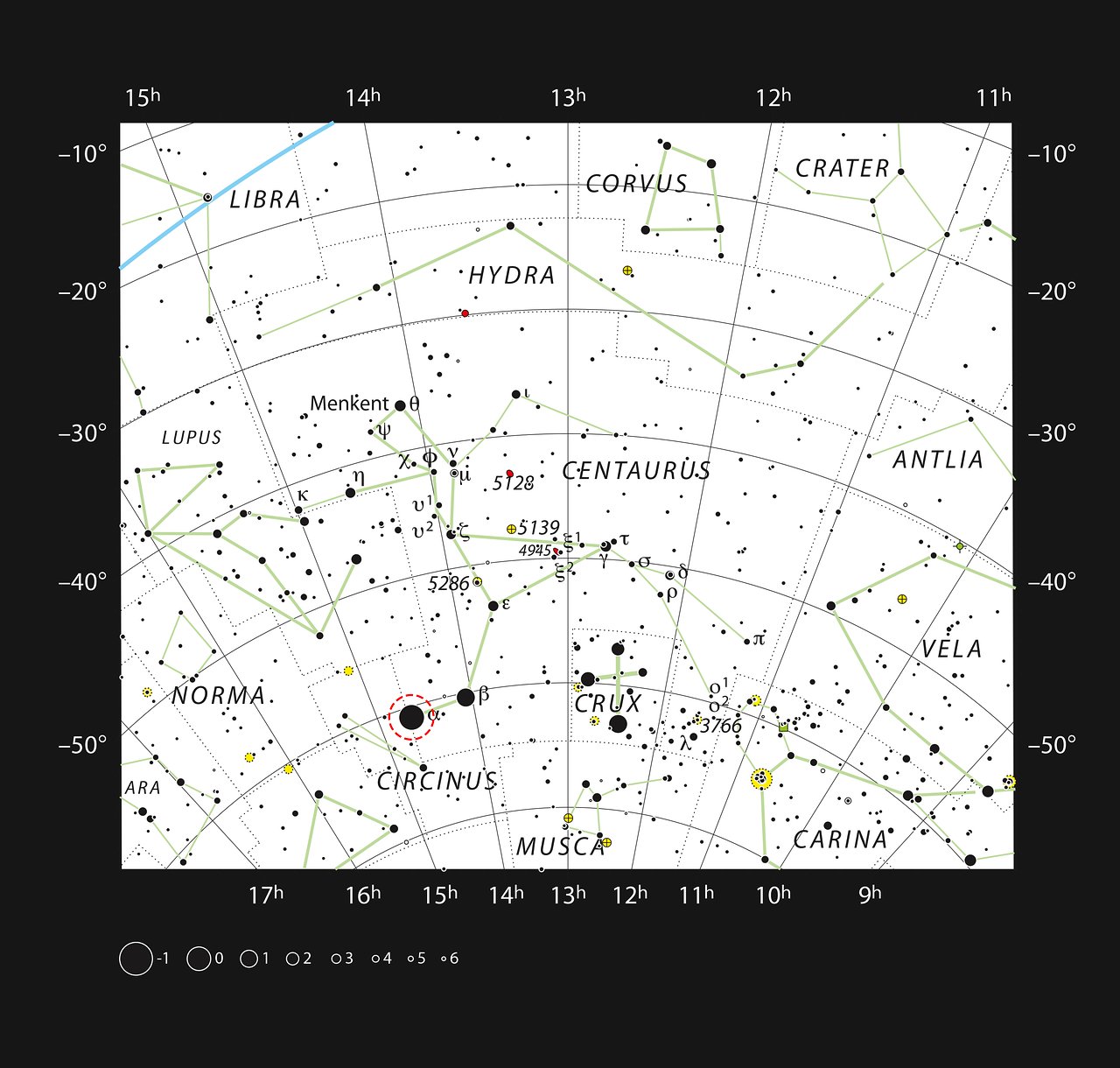
Back south though, at Siding Spring Observatory which has an exceptional dark southern horizon, Alpha Centauri never sets, as the brightest star in the "Pointers" near the Southern Cross, at its worst it grazes the southern horizon.

Alpha Centauri is a great small telescope target that I regularly show school students. The double take gasp that occurs, when they look at one star visually then suddenly realize, through the telescope, there are actually two stars usually gives way to a comment like "No way!" or the these days "What the?", as they back away from the eye piece and look again visually and take another look through the eyepiece - as if they are a scientist with two irreconcilable datasets. See there IS little bit of scientist in us all! Finally it all gives way to an extended WWWOOOooowwww!

Image Credit: ESO, IAU and Sky & Telescope

Now we can tell the students that there is a little "earth sized" planet, (but really more like an earth sized "Mercury") orbiting the fainter of the two stars Alpha Centauri b. Of course Alpha Centauri is actually a triple star system, but the much fainter (again) third star, Promixa Centauri is not resolvable in small scopes.

Emerging Kepler data shows us that planets around stars are pretty much the rule not the exception and its interesting to see the different techniques for detecting them.

“This is the first planet with a mass similar to Earth ever found around a star like the Sun. Its orbit is very close to its star and it must be much too hot for life as we know it,” adds Stéphane Udry (Geneva Observatory), a co-author of the paper and member of the team, “but it may well be just one planet in a system of several. Our other HARPS results, and new findings from Kepler, both show clearly that the majority of low-mass planets are found in such systems. This result represents a major step towards the detection of a twin Earth in the immediate vicinity of the Sun. We live in exciting times!” concludes Xavier Dumusque.

So next time you use the "pointers" to point out the southern cross and south celestial pole, remember you are also looking at what will always be the closest earth sized planet - our near neighbor, or as we still reserve the right in Australia to reject US based spell checkers, not only is it upside down it can also be - Near Neighbour!

Saturday, October 13, 2012

Comet Hergenrother in Outburst

Today we are broadcasting live an interview with Carl Hergenrother and several astronomers across Asia.

Comet 168P Hergenrother has gone into outburst, and brightened several magnitudes. We take a look at a number of great images of the comet and discuss with Carl why this might have happened.

Carl was on the Catalina Sky Survey team and is now the Co-Lead Staff scientist on the OSIRIS-REx Target Asteroid mission.

Enjoy!

Friday, October 5, 2012

Astroswanny at Siding Spring

Joining us virtually in a Google+ Hangout live from South Australia was Dr Ian Musgrave who caught the grazing Occulation of Jupiter by the Moon early in the morning.

A great interview with Peter from the Research School of Astronomy and Astrophysics at the ANU.

Here is our first live cross on the mountain as the iTelescope.net guys took over the most amazing "office space" in the southern hemisphere.

The wonders of truly dark sky are simply breathtaking!

As a young boy, I went on camping trips with the family to some of Australia's most amazing and remote national parks. Armed with a banged up old pair of binoculars, that my Dad bought to watch Greg Chappel's magnificent cover drives at the Gabba, I would sit for hours sweeping the heavens, marveling at the majesty above.

Warrumbungle Ranges National park was my favorite, although very hot during summer, which limited some of the walks we did, it had the additional advantage of being the Astronomy Capital of Australia.

Nearly four decades later, as I sit on top of the mountain near the 3.9m AAT, I marvel at the fact the skies are still as dark and amazing as ever, yet perhaps I appreciate them even more now.

On this trip I bought my 14inch Skywatcher which has a whole lot of light pulling power! Not that you need it, with some Messier objects being naked eye standouts, I was again blown away by the incredible beauty. The Tarantula Nebula almost filled the entire field of view.

The purpose of me being here, this time, is to assist with the Siding Spring Observatory Open Day tomorrow the 6th. Like me four decades ago, hundreds will descend on the SSO tomorrow and many will capture the passion of Astronomy for the first time.

With the new iTelescope.net observatory nearing completion a new chapter will begin making the mountain more accessible to everyone, promoting the great work of everyone at the Anglo Australian Observatory, the Research School of Astronomy and Astrophysics and the ANU, creating great opportunities and pathways into the grad programs for the next generation of scientists.

iTelescope.net observatory will bring great photographic opportunities to the southern skies, better coverage of the Variable star catalog, more eyes on the approaching asteroids.

Last night I spent hours out under the stars, not doing anything in particular, just bouncing around to various Nebula and globular clusters. Playing with my DSLR and fine tuning things. This photo shows all the trials and pit falls of astro-photography.

Image Credit - Peter Lake - M17 Swan Nebula Dobbie and a DSLR ;-)

You can see the collimation of the telescope is not the best, the focus is slightly off and the 15 sec image shows some traking issues. Not surprising for the type of dobbie, and given I threw it together as fast as I could. Having taken some test shots, I can fix the collimation, and get the camera in better focus.

All this off course is easy (most of the time) on my other telescope the magnificent beast that is iT11. You can see the difference that the tried and proven routines of the iTelescope.net scopes bring, why it takes alot of the pain out of the process. Sometimes its fun, just to tinker and refresh your skills at the eye piece, see what you can actually get out of a DSLR that isn't chilled to -35 degress, but just relax and take the time to soak it all up.

Image Credit: Peter Lake - M17 Swan Nebula iT11
So, I'll be out again tonight, and see if I can improve on last nights efforts. If you are around tomorrow and want to come up to Siding Spring and enjoy the open day - come say hi.

Thursday, September 27, 2012

(CCD) Chips .... are happy to see this Seagull !

Image Credit: ESO/Digitized Sky Survey 2 - Davide De Martin

Seagulls, amazing birds, they make a lot of noise and seem to have an uncanny sense of who makes the best chips.

At the MCG in Melbourne, they soar into the night and catch little insects attracted to the bright stadium lights. They have to be chased away by Eagles trucked in to make sure they don't interfere with the precious television rights of footy broadcasts.

In the IT industry, consultants who swoop in with a special solution right about when money is up for grabs, but don't actually tap into the value created by the long suffering hardworking souls how already know what is required, are often referred to as Seagulls also - but I digress.

Somehow we have connected Seagulls to the idea that they are always out to pinch something, yet they are very cheeky, sociable birds that seem to have a lot to say about everything.

So here's one that will pinch your attention, but fill you with awe, without making a single noise.

Stuart Sharpless was a member of the Naval Academy at Flagstaff station in 1953 and proceeded to catalog over 300 emission nebulae. Many of these are in other catalogs already, the distinguishing features of the entries in Sharpless' 2 catalogs completed by 1959 was that the were all emission nebula that were high in HII - Ionized hydrogen, or as we would say today - Astro-photography paydirt!!!!

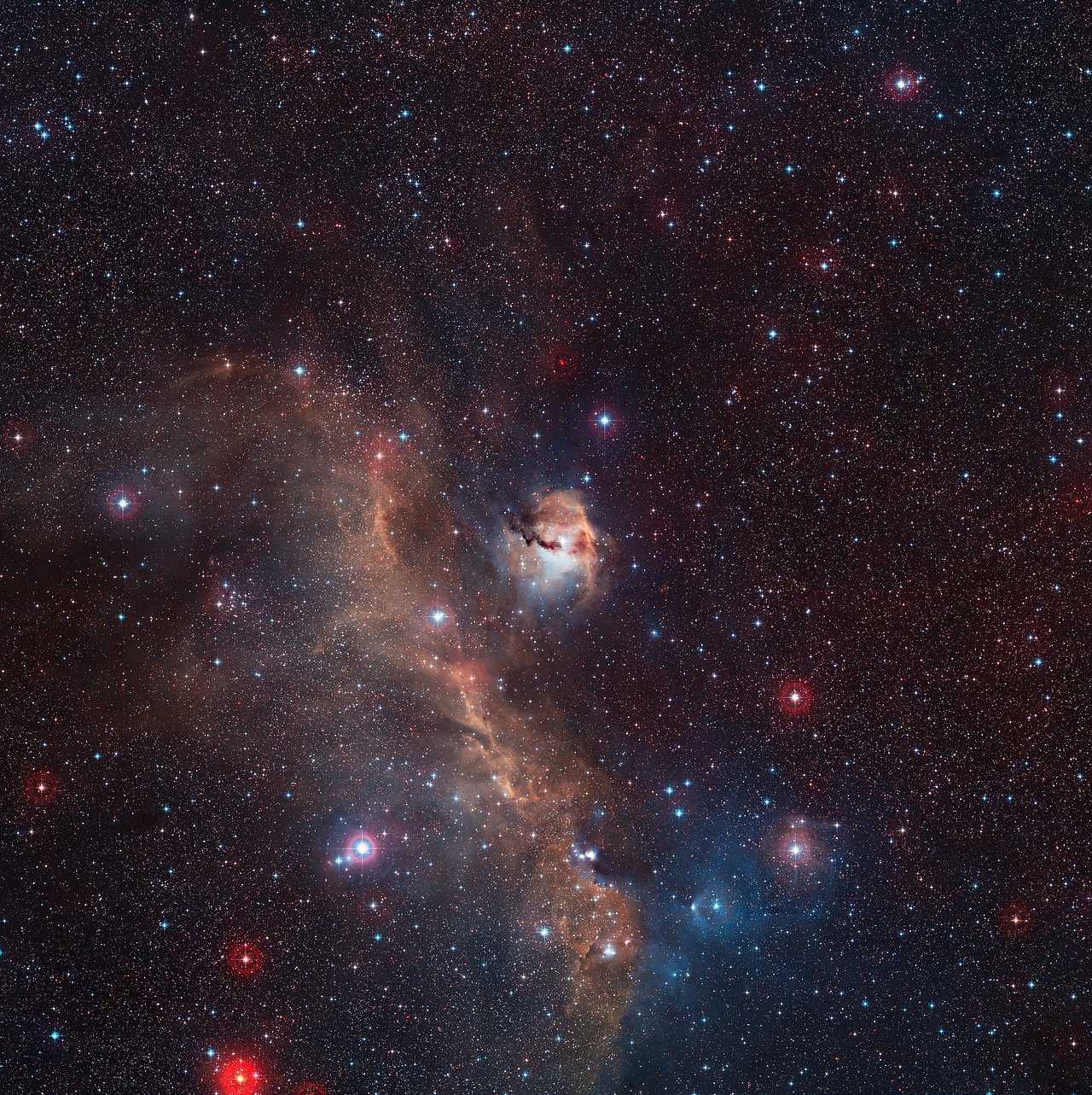
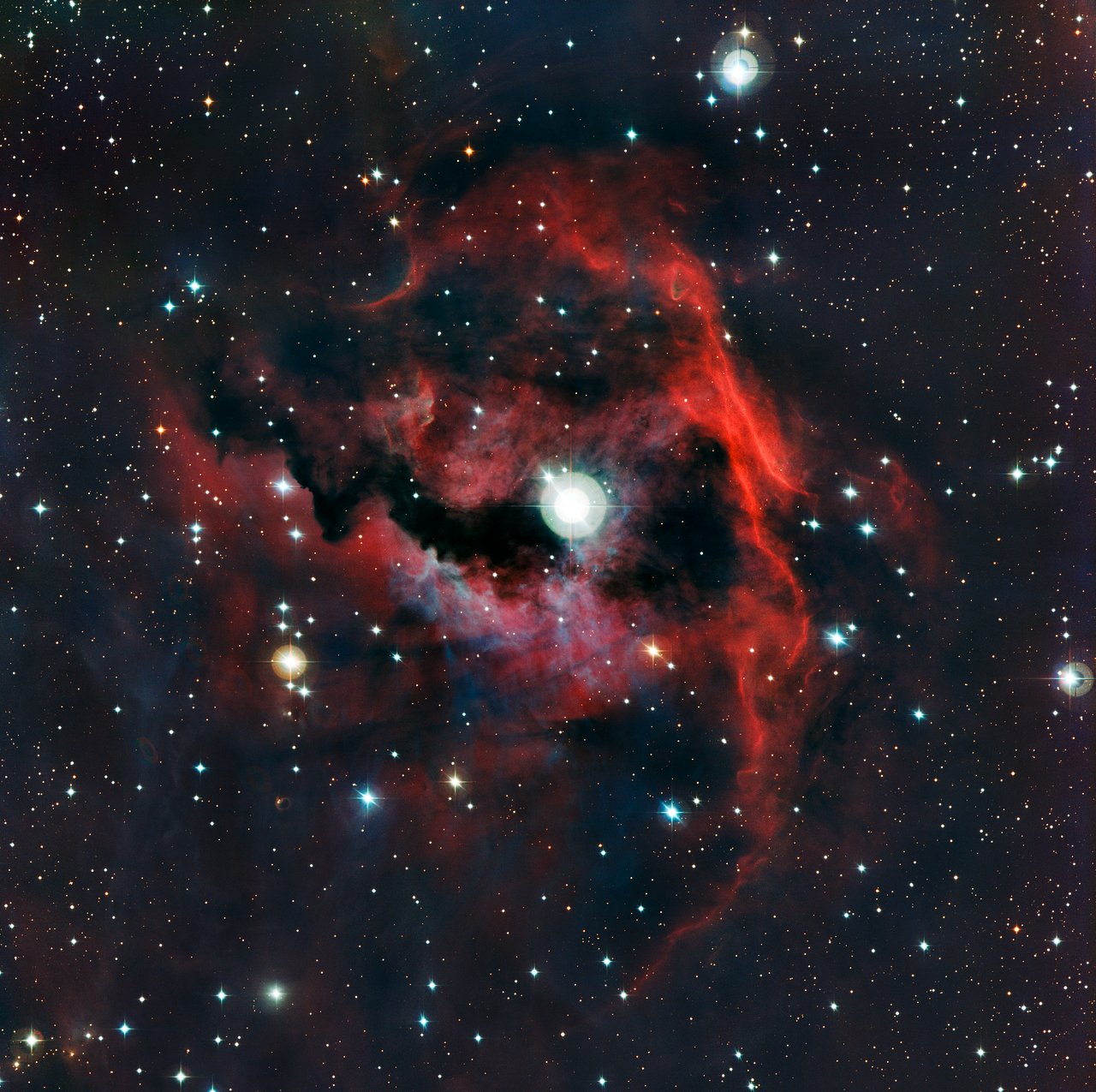
The eye of the Seagull is entry SH 2-292 - Sharpless Catalog 2, number 292. The "Eye of the Seagull" is actually part of the much larger Seagull Nebula. It really does look like a seagull.

Image Credit: ESO La Silla 2.2m Telescope

ESO in its 40th Anniversary year, has today released a new stunningly detailed image of the "Eye of the Seagull" taken from its Wide Field Camera on the 2.2m Telescope at La Silla Observatory. This image is perhaps the deepest ever taken of this amazing object, and features an equally stunning video of the object that zooms in from the "whole of sky" milkyway.

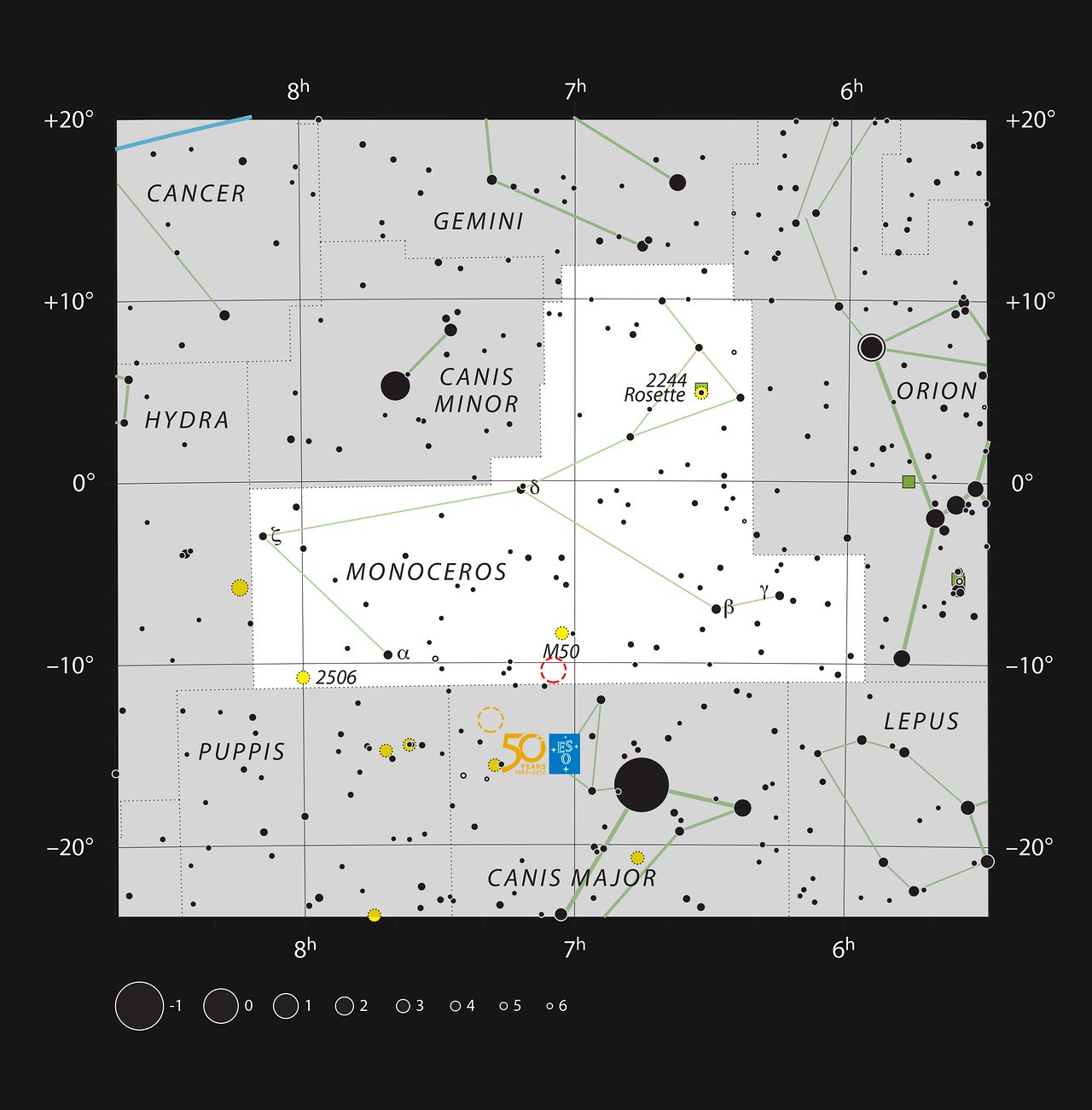
"This new image shows the head part of the Seagull Nebula It is just one part of the larger nebula known more formally as IC 2177, which spreads its wings with a span of over 100 light-years and resembles a seagull in flight. This cloud of gas and dust is located about 3700 light-years away from Earth. The Seagull Nebula lies just on the border between the constellations of Monoceros (The Unicorn) and Canis Major (The Great Dog) and is close to Sirius, the brightest star in the night sky. The nebula lies more than four hundred times further away than the famous star. The complex of gas and dust that forms the head of the seagull glows brightly in the sky due to the strong ultraviolet radiation coming mostly from one brilliant young star — HD 53367 [2] — that can be spotted in the centre of the image and could be taken to be the seagull’s eye. The radiation from the young stars causes the surrounding hydrogen gas to glow with a rich red colour and become an HII region. Light from the hot blue-white stars is also scattered off the tiny dust particles in the nebula to create a contrasting blue haze in some parts of the picture."

Image Credit: ESO, IAU and Sky & Telescope

Of course many of you familiar with the AARTScope Blog would remember my previous (seemingly under done by comparison) effort on SH 2-292. I was very happy with it and it is still one of my favorite images today.

Image Credit: Peter Lake - 18Hrs L, Sii, Ha, Oiii in the Hubble Pallet.

So next time you are at the beach trying to eat your fish and chips in peace, or at the football watching them dodge footballs, athletes and eagles - give a thought to IC 2177 / SH2-292 and remember the Seagull that the chips love - CCD chips that is!!!

The year 2012 marks the 50th anniversary of the founding of the European Southern Observatory (ESO). ESO is the foremost intergovernmental astronomy organisation in Europe and the world’s most productive ground-based astronomical observatory by far. It is supported by 15 countries: Austria, Belgium, Brazil, the Czech Republic, Denmark, France, Finland, Germany, Italy, the Netherlands, Portugal, Spain, Sweden, Switzerland and the United Kingdom. ESO carries out an ambitious programme focused on the design, construction and operation of powerful ground-based observing facilities enabling astronomers to make important scientific discoveries. ESO also plays a leading role in promoting and organising cooperation in astronomical research. ESO operates three unique world-class observing sites in Chile: La Silla, Paranal and Chajnantor.

Search

Custom Search