Sunday, January 13, 2013

99942 Apophis passes earth

Potentially hazardous asteroid 99942 Apophis passed earth this week allowing astronomers a window of opportunity to get some radar data (highly accurate) on it pass.

Astronomers from NASA, JPL and MPC announced that Apophis will miss the earth in 2036, something they were unable to definitely say previously.

I captured these images from the new iT30 0.5m Planewave at iTelescope.net's new SSO observatory.

Also there is a little bonus at the end of the video with a scan code for a free download of my signature shot of the Swan Nebula. Enjoy!

Also please vote in my poll on how bright will Comet ISON be in 2013/2014. (see right hand side bar). I am going to try and up the level of interaction and rate of posts this year, as I am getting so much great feedback from you all.

Happy New Year and a great 2013 to you all!!!

Monday, December 31, 2012

Carnival of Space 281/282

My final honored task for 2012 is to host the Carnival of Space. What a year it has been! From the Transit of Venus, the successful Curiosity landing, the SKA being jointly awarded to Australia and Europe, the Higgs Boson the emergence of +Virtual Star Parties in Google Plus Hangouts, its really hard to know where to start.

Its been an amazing year. Astronomy has in someway led the charge in the Social Media/Science Catagory through strong leadership, mentoring and driving new horizons literally!!!!

To all readers and contributors I hope and trust that 2013 will bring you, and those close to you, a happy, prosperous new year that expands your understanding of the Universe around you, and all the players in its magnificent symphony.

On with the show!!!!!

Cheap Astronomy launches the e-book Astronomy Without a Telescope - which is surprisingly cheap (podcast). eBooks are great and with recent upgrades to smart devices and tablet software you can usually download them really easily into your reading device of preference.

How was born the Moon? Doc Madhattan replies to this quest starting from the Earth-Moon Theory and the works of George Darwin. I also translate some quotations from the short stories by the italian writer Italo Calvino.

The Chandra Blog gives us our first new year's resolution :- Never Give Up And Trust Your Intuition. In fact they push the boundries even further with From Super To Ultra: Just How Big Can Black Holes Get?

The Meridian Journal reports on the Cassini probes discovery of an alien version of the ‘Nile River’ on Titan.

Next Big Future brings us a report on how Orbitec has flown a radical new engine technology that promises to cut the size, weight and therefore the cost of putting a rocket – and payload – into space. Regular rocket engines get incredibly hot, reaching temperatures upwards of 3,000C (5,400F) or more, hot enough to melt the metal chamber in which the rocket fuel mixes with oxygen and burns. At these extremes, even rockets with sidewalls made of heat-resistant superalloys would fail catastrophically. Orbitec’s alternative approach keeps the hot burning gases away from the chamber surfaces altogether. The company’s patented designs create a cyclonic swirl, or vortex, of fuel and oxygen that holds the searing gases and fumes in the very centre of the cylindrical combustion chamber, away from the vulnerable sidewalls.

The meticulous chronicler of all things relating to Space Missions - Amy Shira Teitel discusses the story of how being on the Moon inspired Apollo 17's Jack Schmitt to write some holiday poetry. I'm sure its better than Vogon poetry!

From the Links through Space Blog you can follow Astronomy Club Toutatis on it's trip to Morocco. A series of posts and photos on Moroccan astronomy and personnel experiences through out Marrakesh and the Sahara desert night sky. Read about the observatory of Marrakesh, Asteroid Toutatis, see the Geminid meteor shower from the desert, Step in the Sahara sky hotel in the middle of nowhere in the Sahara desert for deep sky object photographing.

We occasionally see the magnificent photographer Thierry Legault sneak into Australia for magnificent outback shots. Today he sent Universe Today some images from an aurora-hunting trip to Finland and Norway. As you can guess, the images are awesome!

Finally my own AARTScope contribution of the top five highlights of my Astronomical year, a list which runs to many more than five, but the top five are biggies!

It s been my priviledge to continue the mission of the AARTScope Blog to Create the sense of anticipation and discovery that keeps scientists asking questions once again in 2012, and also host the Carnival of Space a number of times. Thanks for joing us again.

The Carnival of Space is a community of interest blog carnival, bringing together the best and brightest Astronomy & Space Blogs at a single point in space and time (commonly referred to as a web address) each week. Previous episodes can be found here. If you run an astronomy or space science blog you can contact carnivalofspace @ gmail.com to be added to the editorial circulation list.

2012 - That's a Wrap!

Happy New Year to all the Space and Astronomy lovers.

2012 has been a great year and contained many highlights. The most significant was my new found skills in G+ Hangouts thanks to +Fraser Cain and +Scott Lewis mentoring me.

I always try and bring fresh, original and live content at the Astronomy webs.

The highlights of the year were:

5) My article on Astronomy 3.0 was published by the Variable Stars South Newsletter. (Page 14) The newsletter is always an excellent read and can be downloaded in PDF to your tablet of a relaxed read.

4) Hangout on Air coverage of the Comet Hergenrother outburst including an interview with Carl Hergenrother the discoverer of the comet.

3) Asteroid Hunt for OSIRIS-Rex Target Asteroids in front of a live audience at a Learning in the Laneway Session at the Little Mule Cafe in Melbourne.

2) A live outside broadcast of the Transit of Venus from Siding Spring, NSW.

1) A live Exo-planet Transit of Qatar-1-b broadcast in a G+ "Hangout on Air" for #deSTEMber

All in all, its been a great year, thanks for everyone who has visited my blog, over 3000 per month now.

We have had visitors from nearly every continent on earth. I hope you all feel welcome, I have added the Google Translate widget to the Blog this year, and whilst its not always perfect with the many scientific terms we need to cover, I hope that you embrace it as a genuine attempt to relate in your native tongue.

I hope and trust that 2013 will bring you, and those close to you, a happy, prosperous new year that expands your understanding of the Universe around you,and all the players in its magnificent symphony.

Saturday, December 8, 2012

Live Exoplanet Transit of Qatar 1b to celebrate #deSTEMber

Today we bring you a world first.

A live extra-solar planet transit of Qatar-1b.

We are just about to get started. I won't have much time to update the blog as we go but sit back and watch the +Google Plus Hangout on Air feed.

Thanks for those who joined us LIVE. Here is the replay if you couldn't.

Thanks to +Scott Lewis, +Shahrin Ahmad, +Tamara Hudgins for your assistance in a highly successful event.

Ingress

Midtransit data from VPHOT

Past the mid-point

However the "shot of the day" came from the all sky camera itself with a stunning meteor just before the broadcast started.

So the final wrap up - we sorted out the little glitch towards the end, and restarted the scope and captured the last part of the transit ok - PHEW. Here is the reduced data and final lightcurve of the transit.

Also here is the reduced data submitted to TRESCA.

Wednesday, December 5, 2012

Sensational Singapore Photostudy

Taking a brief detour from my usual fare of Astronomy.

Recently I have been exploring the various epub and document publishing "iHouses". There are some very interesting approaches, methods and websites.

Here is my first foray, a photographic study of one of my favorite cities -SINGAPORE!!!!!

There is lots to consider, the tools you use to tell the story, the platform you want to publish on, and what the ultimate purpose is (getting it out there vs revenue). Depending on whether you want to just stick a PDF on your blog with a paypal button, "go Apple" through the iTunes store, or get a company like Bookbaby to go the whole way with ISBN Numbers and distribution channels - there is something for everyone.

This time I'm using the ISSUU Website which seems to have a large user base with a broad range of content.

Let me know what you think.

Astroswanny

Saturday, October 20, 2012

Near Neighbor

Image Credit: (c) Peter Lake - Southern Cross and Pointers - SSO, Cannon 550D SLR

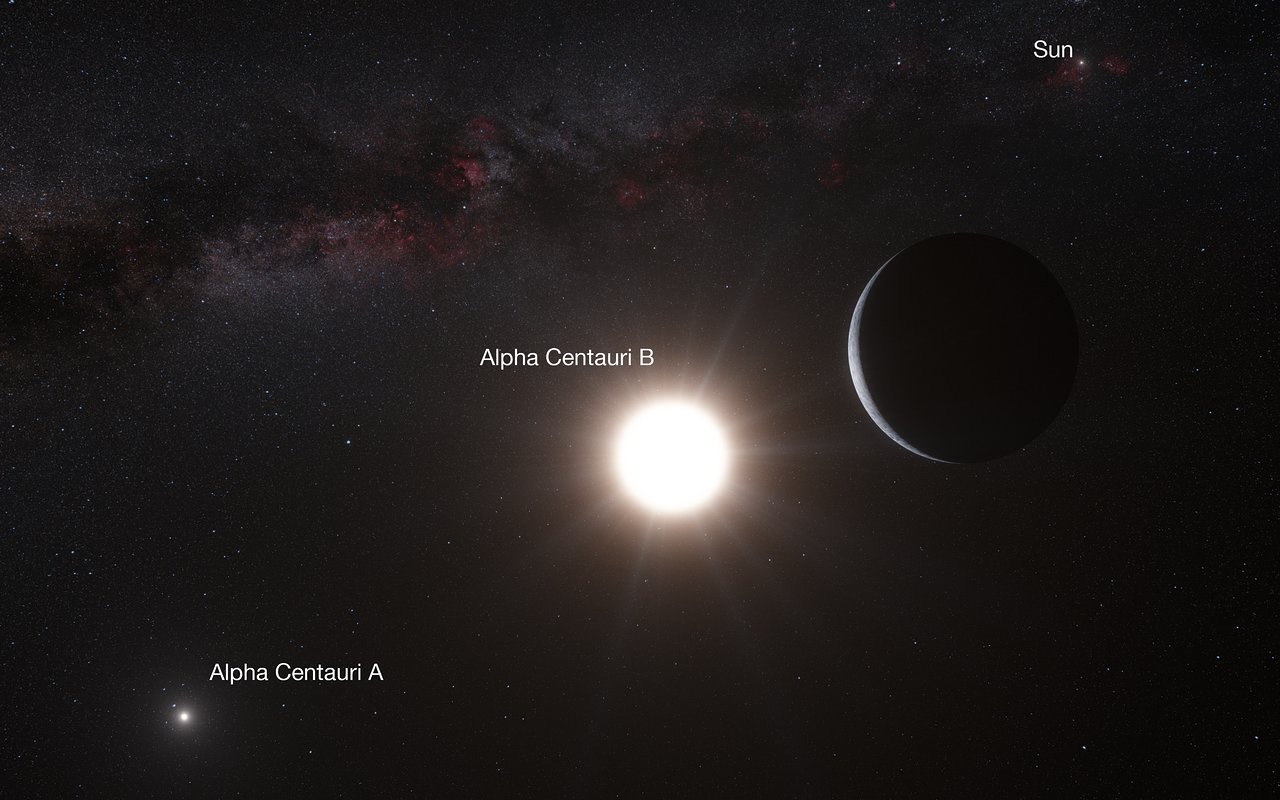
One of the most prominent stars is the southern hemisphere made headlines this week as a team of astronomers, using the ESO Harps Instrument on the 3.6m La Silla observatory in Chile, announced the discovery of an earth sized planet around our closest star.

“Our observations extended over more than four years using the HARPS instrument and have revealed a tiny, but real, signal from a planet orbiting Alpha Centauri B every 3.2 days,” says Xavier Dumusque (Geneva Observatory, Switzerland and Centro de Astrofisica da Universidade do Porto, Portugal), lead author of the paper. “It’s an extraordinary discovery and it has pushed our technique to the limit!”

Image Credit: ESO/L. Calçada/Nick Risinger (skysurvey.org)

Much of the recent news of Extrasolar planet discovery has centered around the Kepler Space Telescope mission, only this week Chris Lintott's & Meg Schwab's team at Planethunters.org also announced the first citizen science discovery of a planet in a 4 star system....come to think of it that has a nice ring to it. ;-)

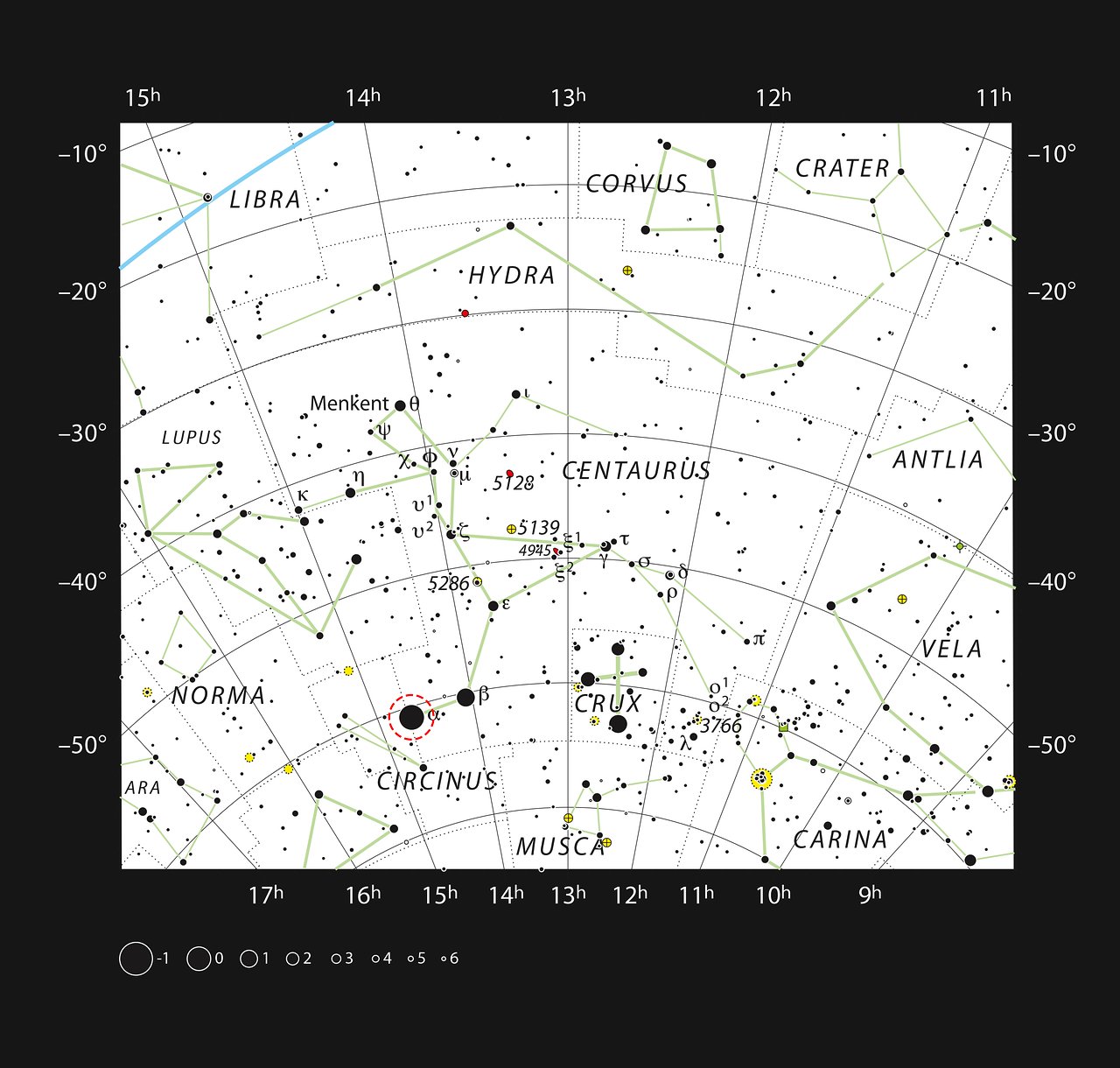
Back south though, at Siding Spring Observatory which has an exceptional dark southern horizon, Alpha Centauri never sets, as the brightest star in the "Pointers" near the Southern Cross, at its worst it grazes the southern horizon.

Alpha Centauri is a great small telescope target that I regularly show school students. The double take gasp that occurs, when they look at one star visually then suddenly realize, through the telescope, there are actually two stars usually gives way to a comment like "No way!" or the these days "What the?", as they back away from the eye piece and look again visually and take another look through the eyepiece - as if they are a scientist with two irreconcilable datasets. See there IS little bit of scientist in us all! Finally it all gives way to an extended WWWOOOooowwww!

Image Credit: ESO, IAU and Sky & Telescope

Now we can tell the students that there is a little "earth sized" planet, (but really more like an earth sized "Mercury") orbiting the fainter of the two stars Alpha Centauri b. Of course Alpha Centauri is actually a triple star system, but the much fainter (again) third star, Promixa Centauri is not resolvable in small scopes.

Emerging Kepler data shows us that planets around stars are pretty much the rule not the exception and its interesting to see the different techniques for detecting them.

“This is the first planet with a mass similar to Earth ever found around a star like the Sun. Its orbit is very close to its star and it must be much too hot for life as we know it,” adds Stéphane Udry (Geneva Observatory), a co-author of the paper and member of the team, “but it may well be just one planet in a system of several. Our other HARPS results, and new findings from Kepler, both show clearly that the majority of low-mass planets are found in such systems. This result represents a major step towards the detection of a twin Earth in the immediate vicinity of the Sun. We live in exciting times!” concludes Xavier Dumusque.

So next time you use the "pointers" to point out the southern cross and south celestial pole, remember you are also looking at what will always be the closest earth sized planet - our near neighbor, or as we still reserve the right in Australia to reject US based spell checkers, not only is it upside down it can also be - Near Neighbour!

Saturday, October 13, 2012

Comet Hergenrother in Outburst

Today we are broadcasting live an interview with Carl Hergenrother and several astronomers across Asia.

Comet 168P Hergenrother has gone into outburst, and brightened several magnitudes. We take a look at a number of great images of the comet and discuss with Carl why this might have happened.

Carl was on the Catalina Sky Survey team and is now the Co-Lead Staff scientist on the OSIRIS-REx Target Asteroid mission.

Enjoy!

Search

Custom Search